

By Dr. Katherine Jewett, PsyD, LMFT | Time to Thrive Therapy
You read the same email three times. A small question feels like one demand too many. You tell yourself to keep going because nothing dramatic has happened, but the ordinary tasks are becoming harder to hold together. If you are feeling overwhelmed, it may help to narrow the question to what needs attention next.
When several demands are competing for your attention, it can be hard to choose where to begin. You can make one practical adjustment without first solving every problem or deciding exactly why you feel this way.
Stress can show up in attention, sleep, mood, and physical discomfort. Those signs are not specific enough to diagnose the cause on their own. The CDC describes trouble concentrating, changes in energy, and difficulty making decisions among possible responses to stress. [1] New or concerning symptoms deserve medical attention rather than an assumption that stress explains them.
When you are feeling overwhelmed, name the immediate difficulty
Instead of asking, “Am I handling everything badly?” describe something concrete. “I have reopened this message four times.” “I am answering before the other person finishes.” “I keep postponing a decision I usually find straightforward.”
With the email, it helps to notice where you get stuck. Are you interrupted? Worried about how to answer? So tired that the words are hard to take in? Those possibilities suggest different responses. You might need the question clarified, a quieter moment to read, or help with a workload that has become too much. Start with what is making this particular task difficult.
Make the demands visible
On paper or in a private note, list what is asking something of you right now. Include the responsibilities you are carrying in your head as well as the tasks on your calendar.
For example, someone might list: finish a work document, arrange a ride for a relative, decide what to cook, and remember to respond to a difficult message. The unfinished decisions may be part of the strain even when they take up little space in the diary.
Next to each item, write what the next step actually is. “Deal with everything about the appointment” might become “Find the appointment time.” A smaller description will not solve a structural workload problem, but it can show you where a task begins.
This is a reflection exercise, not a test or a treatment protocol. Keep the note as brief as useful.
You can also consider whether pressure to get every task right is making a smaller version difficult to accept.
Choose one demand to change
Ask which item can reasonably be delayed, simplified, shared, or clarified. Your circumstances determine what is available. A parent caring for a sick child may have different options from someone choosing between optional errands.
If you can delay something, name the new time: “I can review this tomorrow morning.” If you can simplify it, name the smaller version: “Dinner will be something easy tonight.” If someone else needs to help, make the request concrete: “Could you make the appointment call this afternoon?”
Sometimes the uncertainty is the demand. You might ask, “Which of these two tasks needs to come first?” or “What needs to be finished today, and what can wait?”
If you are caring for a sick child and also expected to finish a report, you may be facing two responsibilities that cannot both get your full attention. If it is safe to raise this at work, you could say, “I’m caring for my child today. I can send the figures by four, but I can’t complete the full report. What should we move?” The answer may not resolve the problem. You are making the conflict visible, rather than quietly agreeing to work you cannot finish.
If family responsibilities that have become too much are a recurring part of the load, it may help to review which tasks you have taken on.
Tell someone enough to make the change possible
You do not have to give a detailed personal explanation to make a practical request. You could say, “I have more on my plate than I can complete today. I can finish the first item or the second. Which is more useful?”
At home, you might try, “I am having trouble keeping track of everything tonight. Can we choose the two things that matter most and leave the rest?”
The other person may need to negotiate. A clear request gives you something specific to discuss. It does not guarantee agreement, and it may not be safe to express every need in every relationship. Use your knowledge of the situation and seek support when speaking up could bring retaliation.
Check what is still needed
After making an adjustment, ask a practical question: “Can I do the next step now, or do I need something else?” You do not have to feel calm for an adjustment to be worthwhile.
If the same difficulty returns often, you might keep a short record of when it happens and what was going on. NIMH recommends identifying stress triggers and finding coping approaches that fit you; it also advises seeking professional help when symptoms persist or interfere with everyday life. [2]
Bring your observations to a qualified health professional if you are struggling to cope, or if symptoms are persistent, unfamiliar, or affecting your functioning. A brief note about what you notice can help you describe the problem without having to explain it perfectly.
The first conversation may be as small as asking, “Can I send this tomorrow morning?” If the answer is no, you can ask which part is needed today. You may still have more to carry than you can comfortably manage, but you will have a clearer answer about this one task.
Free One-Page Guide: What Can Wait?
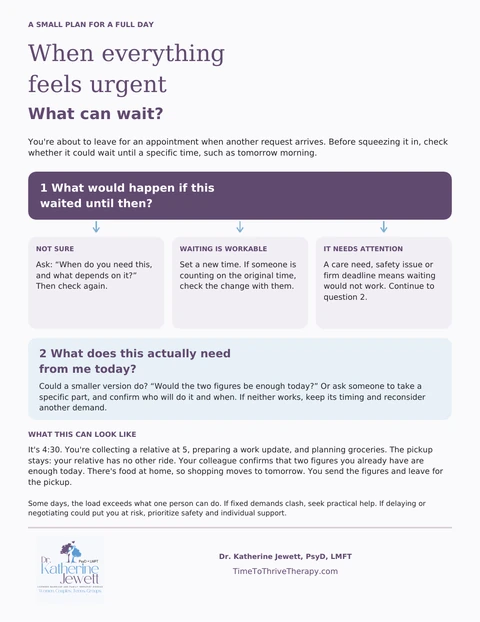
What Can Wait? is a free, one-page guide you can use when everything feels urgent. Its two questions can help you decide what needs attention today, what can wait, and where to ask for help.
Download Your Free Guide (PDF)
What you will need
- The one-page guide on a phone, tablet or computer, or a printed copy.
- One current task or request to think through.
- Optional: a pen and paper, notebook or notes app to record your next step.
- Deadline information, or someone you can ask to clarify the timing.
How to use the guide
- Choose one task or request and a specific later time you are considering.
- Ask what would happen if it waited until then. If the timing is unclear, ask when it is needed and what depends on it.
- If waiting is workable, set the new time and check the change with anyone counting on the original timing.
- If a care need, safety issue or firm deadline means it cannot wait, consider whether a smaller version would be enough. Confirm that with anyone relying on it.
- If you need help, ask someone to take a specific part and agree who will do it and when. If neither a smaller version nor help is possible, keep the timing and reconsider another demand.
You can use the questions without writing anything down. The PDF is not a fillable form; printing is optional.
Dr. Katherine Jewett, PsyD, LMFT
California LMFT license 100342
This article provides general education and does not replace individualized medical or mental health care. Examples are illustrative and are not client stories.
Sources
- Source 1: CDC, Managing Stress, updated May 12, 2026.
- Source 2: NIMH, I’m So Stressed Out Fact Sheet.