
By Dr. Katherine Jewett, PsyD, LMFT | Time to Thrive Therapy
“I can help with the groceries.”
You are grateful to hear it. You also wonder who will make the list, check what is already in the kitchen, ask about substitutions, arrange delivery, and notice when the groceries are running low again. If all those steps stay with you, the offer may cover less than either person realizes.
November is National Family Caregivers Month, an opportunity to recognize family care and the support it requires. [1] One useful question is very practical: What does it mean for someone to take on one task all the way through?
I would start with a manageable piece of care, rather than a promise to reorganize everything. A clear handoff gives both people a chance to understand the responsibility before agreeing to it.
Include the person receiving care
Caregiving arrangements affect someone whose preferences, privacy, and choices matter. The National Institute on Aging recommends identifying care needs and deciding who will handle which responsibilities, with the older person involved in the conversation. It also advises revisiting arrangements when needs or availability change. [2]
In the grocery example, begin by asking the person receiving help what they want and how they prefer to be involved. They might want to choose items themselves, review a proposed order, or keep buying some things independently.
Help should not automatically become authority over someone else's routines. Clarify what has actually been requested, and seek appropriate professional guidance if questions about decision-making ability or legal authority arise. A family agreement does not resolve those questions by itself.
FREE PRACTICAL GUIDE
Identify a task you can discuss sharing
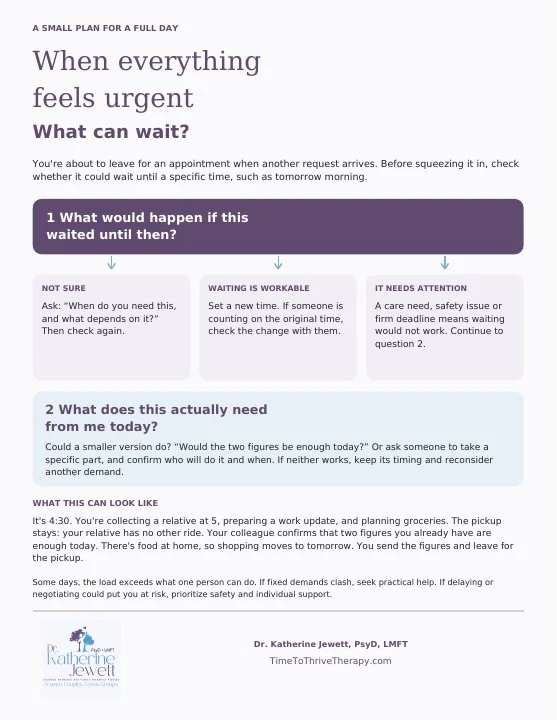
My What Can Wait? guide can help you pause over a full list and consider what needs attention, what can be smaller, and where you might ask for help. Use it to identify an ordinary task to discuss, then use the handoff steps in this article to clarify ownership, consent, and any needed backup.
Download the free What Can Wait? guide
Use paper or a notes app to think through an ordinary task. Essential care or urgent safety needs require an appropriate plan, not simply putting them off.
Make the edges of the task visible
“Groceries” is a heading. A handoff needs to explain what falls under it this week.
You might ask, “Could you handle Saturday’s grocery order? Please ask Lee what they need on Thursday, check the usual staples with them, and place the order within the budget we agreed on. You’ll also need to arrange a time when they can receive it.”
Then say what is outside the task: “This does not include changing the meal plan or buying medications. Please check with Lee if an item is unavailable rather than deciding what they should eat.”
Those details are useful because people may picture different jobs when they hear the same word. Naming the edges also gives the helper a fair chance to say, “I can place and collect the order, but I cannot be available Thursday.”
If one person remains responsible for noticing and organizing everything, uneven family responsibilities may need a wider conversation.
Agree on the information and access needed
A handoff may require a shopping list, a preferred store, a spending limit, or instructions for reaching the person. Share only what is necessary and appropriate, with permission where needed. A group message about groceries does not need everyone's medical history or financial documents.
Avoid solving access problems by casually passing around passwords or payment details. Ask what authorized arrangement is available. If paying for the order has not been resolved, name that before someone makes a commitment or spends money.
For medical tasks, use the care team's instructions and appropriate training. This article's grocery example is not a guide to delegating medication, equipment use, helping someone move from a bed to a chair, or other clinical care. Those responsibilities need their own safety requirements and a clear route for questions.
Check the handoff in both directions
Ask the person taking the task how they expect it to work: “Would you be able to check the list with Lee on Thursday, or do we need a different day?” Their answer may reveal a missing step or a scheduling problem neither of you had noticed.
They might reply, “I will ask Lee for the list Thursday, place the order Friday, and confirm the delivery time. If I cannot get an item, I will ask Lee about it.” You may notice that no one has agreed who will carry the bags inside. That is useful information to catch before delivery day.
The person handing over also has work to do. If a necessary detail is known only to you, make it available in a usable form. Once the arrangement is clear, distinguish essential questions from preferences about your own usual method. The order does not have to be placed in exactly your way to meet the agreed need.
Decide what happens when the plan breaks
A helper may become unavailable. A delivery may be canceled. A care need may change. Agree who will communicate the problem and how early a backup needs to be arranged.
“If you can’t cover Saturday, please let Lee and me know by Friday noon. I can’t be the backup this week, so we need to agree on another option before relying on this plan.”
Then work through that possibility. Is there someone who has agreed to collect an order, or an affordable delivery option Lee can use? If there is no safe backup, the problem is still open. A care coordinator, social worker, or relevant community service may be able to help you explore support, depending on cost and availability.
Review the arrangement without grading the person
After the first week, ask what happened. Did the person receiving care get what they needed? Were the responsibilities clear? Did an unseen step remain with the original caregiver? What should change next time?
I would want room for an honest answer from everyone, including someone who discovered that the task was larger than expected. A clear handoff can expose a shortage of support; it cannot create time, money, or capacity that is not there.
Where family discussions involve intimidation or retaliation, seek individual support rather than using a group task negotiation to address the danger. [3]
After Saturday’s order, check with Lee and the person who took it on. Were the right groceries delivered, and was someone able to bring them inside? If you still had to build the list, chase the order, and arrange delivery, those steps need another conversation before next week. You now know which part of the handoff was missing.
This article offers general education, not individualized mental health, medical, or legal advice. The caregiving example is invented, not a client story.
Sources
- Source 2: Sharing Caregiving Responsibilities
- Source 3: Create Your Personal Safety Plan
More support for calm and connection