
Couples Therapy in Pleasant Hill and Online Across California
In person in Pleasant Hill · Online across California
We keep having the same fight. We miss “us.”
Maybe you’re having trouble communicating even about little things. You try to say what’s bothering you, and somehow you end up defending yourself or going quiet. What you really wanted was to feel heard and close again.
One of you says, “I feel like we barely spend any time together anymore.” The other hears, “You’re saying I don’t care,” and starts explaining how much they’ve been doing. The next thing you know, you’re arguing about who does more. The request you meant to make can get lost: “Could we make a little more time for just the two of us?”

California LMFT #100342 · About Katherine
Where we might start
What’s been happening between you?
Maybe you feel more like roommates than partners. Or maybe a painful conflict or a break in trust has changed what you feel you can count on. Here are some other ways the distance can show up.
The same argument keeps coming back.
Even when you start out talking about something small, you end up defending yourself, getting louder, or going quiet. You leave the conversation feeling misunderstood.
You want different amounts of time together.
One of you would love more evenings together. The other feels close with less time together or needs more time alone. Or you both want more time together and can’t see where it would fit.
Something still hurts.
A boundary was crossed, or something was said or done that you never quite worked through. You may have stopped talking about it, but you still feel it when you try to get close.
You miss the affection or passion you used to feel.
You can get through the day together and still miss being playful, touching, or feeling wanted.
Parenting puts you on opposite sides.
You disagree about how to handle something with the kids, and afterward you’re left feeling unsupported by each other.
In couples therapy, we can slow down one of those moments and look at what each of you was trying to say and what the other heard. Looking at more than one of those moments can help us see what they have in common.
Your Connection Blueprint
What often surprises couples is how much they learn about themselves and each other. We’ll look back at a few different challenges you’ve faced. Maybe one was about parenting and another was about money. The topics may be different, but what happens between you can feel remarkably familiar.
We’ll look at what happens inside each of you and how your reactions affect each other. For example, one of you may push for an answer because you feel alone with a decision. The other may go quiet because it feels like whatever you say will make things worse. When you can hear what was underneath those reactions, it’s easier to understand why the same pattern keeps showing up.
Some of what you bring into these moments may come from the family you grew up in or from earlier relationships. Maybe you learned you had to keep asking before anyone would hear you, while your partner learned that staying quiet kept things from getting worse. Knowing where those reactions came from can help you make sense of your own response and hear your partner’s differently.
Imagine being halfway through a hard conversation and realizing, “This is where we usually lose each other.” That’s what I want your Connection Blueprint to help you see. It’s specific to the two of you: why a moment that feels small to one of you lands so hard for the other, and where there’s room to respond differently. When you can both see what’s happening, you have a chance to catch it together, before you end up on opposite sides again.
What sessions look like
We start by hearing from both of you.
I’ll ask what brought you in, when you still feel connected, and where you get stuck. We’ll talk about what each of you hopes will change and decide together where to start. If we need a clearer picture, we can also use a structured relationship assessment.
1. Slow down one real moment.
We might take an argument from this week and walk through how it started, what each of you heard, and what you did next.
2. Try a different response together.
You might practice showing your partner why you can understand what hurt, even if you remember the conversation differently.
3. Find a way forward where you’ve been stuck.
Together, we’ll build a new toolkit that fits the two of you. You’ll have new ways to get unstuck when you fall into familiar patterns, and you can keep using what you learn to understand each other better, build trust, and grow closer.
The goal is to feel more like partners in the life you’re building together. We’ll work on what that looks like for both of you, one conversation at a time.
Free communication worksheet · Week 7
Why Do We Keep Having the Same Argument?
Start with a small disagreement that keeps coming up. This exercise helps you take turns saying what you want the other person to understand, check that you heard each other right, and agree on one small change to try.
Download the free communication worksheet Two pages: a short guide and a fillable worksheet. Print it or type into it. No sign-up needed.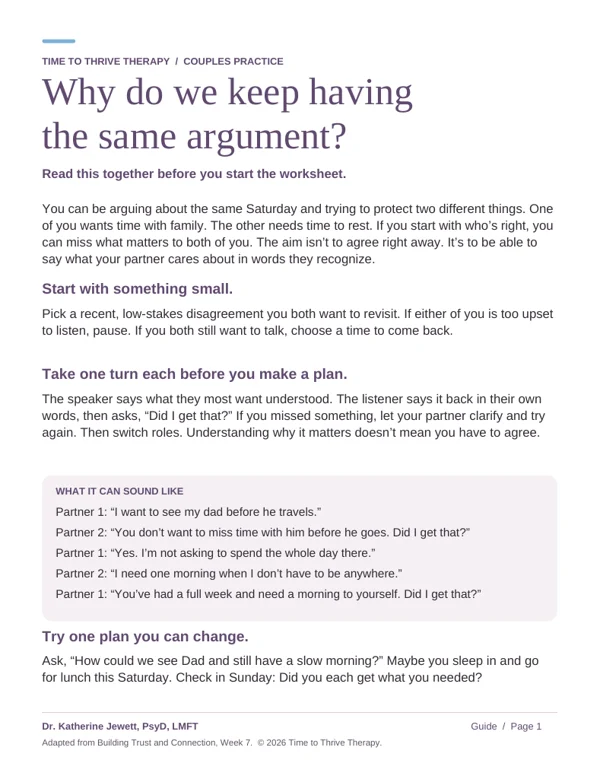
Not quite ready for couples therapy?
If you’d rather start at home, try the free worksheet above. If you want more to work on together, my Building Trust & Connection course is coming soon. It’s a self-guided course for couples who want to understand where they get stuck and build more trust in everyday life.
Frequently asked questions
Can couples therapy help us communicate better?
Yes. We can start with a conversation you actually had. I’ll help you slow it down, check what each of you heard, and practice saying what you need in a way your partner has a chance to hear. If you’re already taking breaks but aren’t sure how to start talking again, here’s how to return to a conversation after a pause.
Can couples therapy help if we feel more like roommates?
Yes. You can come in even if you rarely fight. We can look at how the distance shows up for each of you, what you miss, and how to make room for more affection, conversation, or time together in a way that works for you both.
Can couples therapy help if we keep having the same argument?
Yes. We can take one recent argument and look at the moment it started to go sideways. You’ll have a chance to hear what your partner was trying to say and practice what you might do differently next time.
What if one of us wants more time together than the other?
We can talk about how much time together each of you wants and what makes that time feel meaningful. From there, you can try an arrangement that makes room for both connection and time on your own.
Can we do couples therapy online in California?
Yes. I offer online couples therapy in California and see couples in person in Pleasant Hill. See fees and insurance information.
Getting started
Let’s talk about what you’re looking for.
In a free 30-minute phone consultation, you can tell me a little about what’s been happening, ask questions about how I work, and see whether it feels like a good fit.