
In person in Pleasant Hill · Online across California
Depression Therapy in Pleasant Hill, CA
Maybe you’ve noticed how much you have to talk yourself into lately. Getting in the shower. Calling a friend back. Even when you do something you usually love, you might find yourself thinking, Why can’t I just enjoy this?
If we were sitting together, I’d want to know what feels harder for you now than it used to. Maybe there’s something you miss doing. Maybe you miss how you used to feel when you did it.

California LMFT #100342 · About Katherine
When you haven’t felt like yourself
For some people, the sadness is easy to name. For others, what they notice is how little patience they have left, or how often they’d rather be alone. It can be lonely to miss someone and still let their call go to voicemail because you don’t have the energy to talk.
I’d want to hear how long this has been going on, what else is happening in your life, and how different this feels from your usual self. You can come in with questions. Figuring out what’s happening is part of our work. If a shorter temper is what you’ve noticed, you can read more about how a change in mood can show up as irritability.
What keeps a hard day going?
You might let that call go and then spend the evening telling yourself you’re a terrible friend. Now you’re tired, you miss them, and you feel guilty, too. In counseling for depression, we can slow down a moment like that and look at where you could use some relief.
What you say to yourself
“I’m a bad friend” can feel pretty convincing from the couch. I might ask, “What would your friend want to know about why you didn’t pick up?” Sometimes the more honest answer is, “I really wanted to talk. I was exhausted.” That gives you a different place to go from here.
What your body has been carrying
How are you sleeping? Have meals become hit or miss? Is there a time of day when you have a little more energy? We’ll look at those details together. If every evening ends in a crash, it helps to understand what the rest of your day has asked of you.
What still matters to you
Maybe you miss your sister, but the idea of a long visit feels exhausting. What you want is a few minutes together. “Could you call me on your way home? I’d love to hear your voice” might fit the energy you actually have today.
If that loss of enjoyment feels familiar, you might recognize yourself in When the Things You Usually Enjoy Stop Feeling Enjoyable.
What to expect
How we’d work together
Start with a day you remember
In a first session, I might ask, “When was it hardest this week?” You might tell me you’ve been crying in the car before you go into work, even though you hold it together once you’re there. I’ll ask about mood, sleep, health, support, and safety so we can decide what needs attention first. We’ll also talk about what you’d like to get back to.
Understand where you get stuck
Maybe part of you wants company and another part dreads having to act cheerful. Both make sense. If it fits, we can explore what would make company easier, like spending time with someone who lets you be quiet.
Try something that fits this week
We might use cognitive behavioral therapy to examine a thought like “I always let people down.” Or we might use behavioral activation to try one manageable activity that matters to you. We’ll choose together. Some weeks the most helpful step is asking someone else to take dinner off your plate.
Notice what actually helped
At the next visit, I’ll ask what happened. Did you enjoy the company once you were there? Did it take more out of you than you expected? Either answer helps us decide what to keep, what to change, and where you need more support.
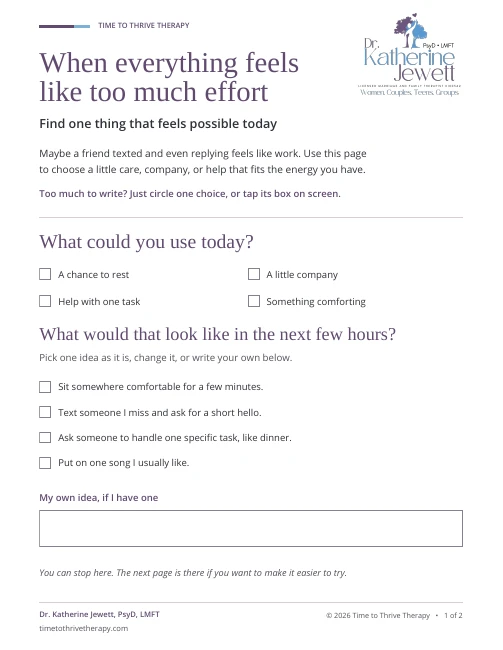
Free printable and fillable worksheet
When everything feels like too much effort
If even choosing what to do next feels like work, start with one box. Would it help to rest, have a little company, or get help with one thing? This two-page guide gives you a few ways to try, including words you can borrow to reach out. On a hard day, circling one answer is enough.
For more tools like this, you can also join The Comfy Couch newsletter.
Frequently asked questions
Can I be depressed and still get through the workday?
Yes. I’d want to hear what it costs you to get through it. Perhaps you can focus when someone is counting on you, but once you’re home you have nothing left for dinner or a conversation. What happens after work is part of the picture, too.
What if I can’t tell whether this is grief, burnout, or depression?
We can sort through that together. I’ll ask what happened around the time you noticed the change, when you feel any relief, and how your sleep, energy, and interest have been. Grief and depression can overlap. If a health issue might be contributing, we can discuss what to bring to your medical provider.
What if I don’t know what to say in the first session?
“I haven’t felt like myself lately” is plenty to begin with. I can ask questions. You can also bring an example from the week, something a person close to you has noticed, or the worksheet on this page.
Will I need medication?
People take different paths. Some work with a therapist, some use medication, and some choose both. If you’re curious about medication, we can talk through your questions and what you’d like to ask a prescribing clinician.
How will we know whether therapy is helping?
We’ll choose changes you’d actually notice. Maybe you’d like to eat breakfast with your family again, or get through a hard morning without spending the rest of the day criticizing yourself. I’ll ask what has shifted, what still feels hard, and what we should do differently.
Can we meet online, and what does a session cost?
Yes. I meet with clients in my Pleasant Hill office and by video when they’re in California. A standard 50-minute individual session is $185. I’m an out-of-network provider and can provide a statement for you to submit to your plan. See fees and insurance details.
For more about symptoms and treatment options, visit the National Institute of Mental Health’s guide to depression.
Let’s talk about what’s changed for you.
In a free 30-minute phone consultation, you can tell me what led you here and ask whatever would help you decide whether you’d like to meet. “I’m tired of feeling this way” is plenty to start with.