By Dr. Katherine Jewett, PsyD, LMFT | Time to Thrive Therapy
“My boundary is that you have to answer my messages immediately.”
The sentence uses a familiar word, but it leaves important questions unanswered. What is the person asking for? What can they decide for themselves? Has the other adult agreed to be continuously available?
I find it useful to look past the label and examine the action. A request, a personal limit, and an agreed household rule can all have a place. They do different jobs, and calling something a boundary does not settle whether it is fair, feasible, or respectful.
I’m focusing here on everyday agreements between adults. These are practical distinctions, not legal definitions. Understanding a particular relationship still requires knowing what happens when someone asks, disagrees, or says no.
A request asks another person to do something
“Could you let me know when you expect to arrive?” asks for an action. The other person can answer, discuss the circumstances, or propose something different.
A usable request says enough to be understood. “Please communicate better” leaves much more to guess than, “If our dinner plan changes, please send an update when you can safely do so.”
Being direct does not require an aggressive tone or a guarantee of agreement. The Centre for Clinical Interventions describes assertiveness as expressing your position while respecting other people's rights, and notes that it does not ensure a desired outcome. [1]
Notice what happens if the answer is no. If your partner says they cannot answer during work and you respond by repeatedly calling or accusing them of not caring, a politely phrased request can still put them under pressure. Their answer needs to be something you are prepared to hear, even if it leaves a problem to discuss.
A boundary describes a limit on your participation or access
A personal boundary might concern your time, body, privacy, or what you will participate in. “I am not available for nonurgent calls after nine” states a limit on your availability. You may explain how you will handle it: “I will return those messages the next day.”
Love is respect describes boundaries as connected to personal comfort, needs, and values, and distinguishes them from attempts to control or harm another person. [2]
You do not always need a consequence to make a limit understandable. “I do not want a hug” is sufficient. If a practical next step is relevant, choose one that you can actually take and that addresses the limit, rather than using an unrelated punishment.
A boundary does not automatically cancel responsibilities you have already accepted. If you are responsible for essential care overnight, “I do not answer after nine” cannot be treated as a complete care plan. You need to address the responsibility and arrange any necessary change safely.
If your limit involves repeatedly taking responsibility for everyone else, family boundaries and overfunctioning provide a broader context.
A shared rule needs a shared understanding
In an ordinary adult household, a rule might be an agreed arrangement: “We both check before inviting an overnight guest.” Each person understands what the arrangement covers and has a meaningful opportunity to discuss it.
Different settings have other kinds of rules, including workplace requirements, leases, and parenting responsibilities. Those situations need their own context. Here, I am focusing on arrangements adults make with each other in daily life.
Consider whether everyone has actually agreed or whether one person's preference has gradually been described as “our rule.” An agreement also needs a way to be revisited. “I no longer think this works for me” is information to discuss, not proof that the original agreement never mattered.
Compare the three in one ordinary situation
Imagine that someone posts a group photo that includes you. You do not want the image shared publicly.
A request could be, “Would you remove the photo and ask me before posting pictures of me in the future?” That identifies what you want the other person to do.
A personal limit might be, “I do not want to be included in photos intended for social media. I will sit this group photo out.” That explains your participation. It does not make someone else's decision to post an unwanted image acceptable or place responsibility for their behavior on you.
A mutual agreement might be, “Let's both ask before sharing photos of each other.” That is a proposed shared practice. It becomes an agreement when both people understand and accept it.
You may use more than one of these in the same conversation. There is no requirement to choose a single category before expressing a concern.
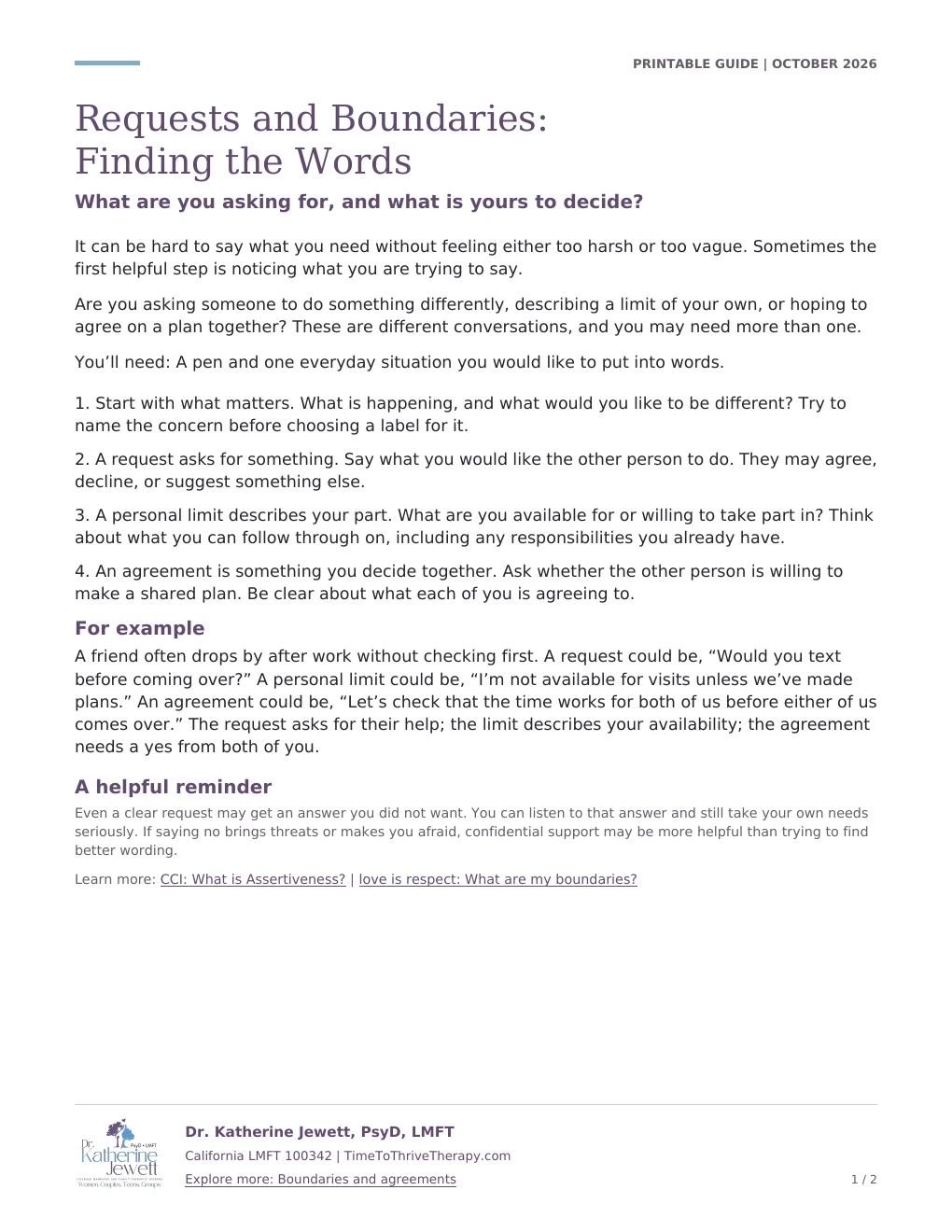
FREE PRINTABLE GUIDE
Requests and Boundaries: Finding the Words
Are you asking someone to do something differently, describing a limit of your own, or hoping to agree on a plan together? These are different conversations, and you may need more than one.
A two-page printable guide. You’ll need: A pen and one everyday situation you would like to put into words.
Check the action behind the sentence
“I will leave the room if this turns into yelling” describes an action the speaker may take, where leaving is safe. “I will make you regret it if you disagree” describes a threat. Both begin with “I.” Grammar alone does not tell you whether the statement respects another person.
Return to the unanswered messages. Are you waiting for information you need to arrange dinner, or are you frightened that a delayed reply means your partner is pulling away? Those concerns may need different conversations. You might need an agreed time to confirm plans, or you might need to talk about what has left you unsure of the relationship. Requiring an immediate reply does not tell you which concern you are trying to address.
I would also look at whether people have real access to choices. A label should not distract from control over someone's money, movement, relationships, or safety. If disagreement brings threats or retaliation, seek confidential individual support rather than trying to negotiate a better label. [3]
You could restart the original conversation with, “I don’t need updates all day. I do need to know whether we’re having dinner together. Could we confirm by five? If we haven’t made a plan by then, I’ll arrange my own meal.” Ask whether that would work. Once you both understand the arrangement, you can decide whether to agree to it.
This article offers general education, not individualized mental health or legal advice. All situations and dialogue are invented illustrations, not client stories.
Sources
- Source 2: What Are My Boundaries?
- Source 3: Warning Signs of Abuse
More support for calm and connection