
By Dr. Katherine Jewett, PsyD, LMFT | Time to Thrive Therapy
“You never tell me when your plans change.”
You may have a real concern. You waited to start dinner, arranged your afternoon around an arrival time, or could not tell whether you needed to make another plan. Yet the conversation quickly becomes a search for exceptions: “I told you last Tuesday.”
Now you are arguing about the word “never,” while the practical problem waits.
Being left waiting still matters. What would you want handled differently next time: an update, an agreed time to go ahead and eat, or less uncertainty about whether you are eating together? Getting clear about that helps you bring the conversation back to the problem you need to solve.
Locate the moment you want to change
Begin with an event you can describe without assigning a motive. “Yesterday you arrived at seven when we had planned for six, and I had not heard that the time changed.”
That sentence does not explain why they were late. It also does not erase the effect on you. You might add, “I waited to eat and did not know whether to call.”
Compare this with, “You think your time matters more than mine.” That may be what you concluded, and the meaning deserves attention. But it is not something you can establish from the arrival time alone. You can say, “I began to feel that my time was not being considered,” while leaving room to understand what happened.
If the problem is recurring, describe the pattern accurately: “This has happened on our last three dinner plans.” You do not need a perfect record or an absolute word to raise a repeated concern.
Ask for something another person could do
“Be more considerate” leaves much to interpret. “If your expected arrival changes, could you send a message when you can safely do so?” describes an action.
The Centre for Clinical Interventions recommends making assertive statements specific and direct. [1] My suggestion is to check your request against an ordinary question: If the person agreed, would either of us know what that agreement looked like tomorrow?
A request can include context without becoming a set of surveillance requirements. “Please update me if we are coordinating dinner” is different from requiring an account of every movement. You are addressing the shared arrangement, rather than claiming access to all of the other person's time.
Avoid turning “I feel” into a disguise for an accusation. “I feel that you are selfish” still makes a global judgment. Try naming the experience and the change: “I felt frustrated waiting. I would like an update when the dinner plan changes.”
Find out whether the request is workable
After asking, pause for a real answer. The other person may agree, propose an alternative, or explain a constraint you did not know about.
Suppose their work prevents phone access until the shift ends. An immediate update every time work runs late may be impossible. You could explore a different arrangement: “Would it work to confirm dinner when your shift finishes? If I have not heard by six, I will go ahead and eat.”
That response keeps the need visible while changing the method. You are seeking a usable arrangement, not testing whether someone can meet an impossible standard to prove they care.
If they keep saying the request will not work, ask what they could reliably agree to: “What would you be able to do when a dinner plan changes?” They may have a suggestion, or they may be unwilling to make any arrangement. You need to hear that answer too, because it affects whether you can keep planning dinner together.
When arrival updates are a repeated concern, reliability in shared plans may be part of the wider discussion.
Let a request have an honest answer
Direct communication does not guarantee that you will get what you want. CCI makes that limitation explicit in its guidance on assertiveness. [2]
Leaving room for a no does not require you to keep an arrangement that repeatedly causes problems. You can decide what you will do with the information: eat at your usual time, avoid committing to a shared meal until it is confirmed, or discuss whether the larger pattern meets your needs.
Be careful about attaching unrelated consequences. “Text me or I will ignore you for the weekend” does not help coordinate dinner. It introduces punishment. A next step should address what you can reasonably choose, rather than create pressure through distress.
Keep the concern intact if the wording was imperfect
Perhaps “always” has already come out of your mouth. You can correct it without abandoning the subject.
“You are right that it does not happen every time. I want to be accurate. It happened yesterday and twice last week, and I still need us to work out how we handle changed plans.”
The person receiving a request also has a choice. If you understand the concern, you can acknowledge it instead of making imperfect wording the entire conversation. “I do send updates sometimes. I also see that yesterday left you waiting.” Both statements can be true.
After this conversation, would you both know what happens if someone is late tomorrow? If you agreed on an update and it still does not come, you have a follow-through problem to discuss. Rewriting the request again may not address that.
If the same exchange keeps breaking down, a broader communication pattern may deserve attention alongside this specific request.
If asking leads to threats, control, or retaliation, seek confidential individual support rather than practicing firmer wording with that person. [3]
You might bring the conversation back this way: “I got caught up arguing about whether you ever send updates. What I need us to decide is what happens when one of us is running late. Could we agree on a time when the other person goes ahead and eats?” That gives the person something specific to answer and you something specific to return to.
This article offers general education, not individualized mental health care. All situations and dialogue are invented illustrations, not client stories.
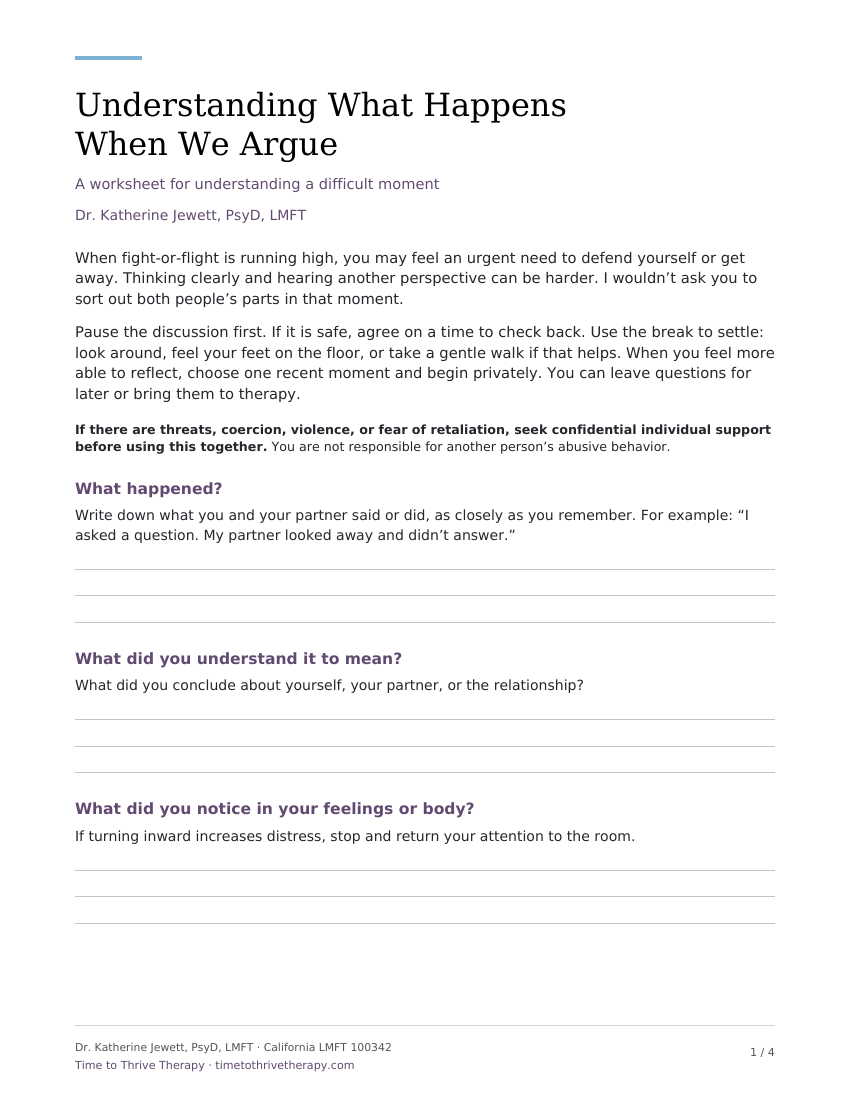
FREE REFLECTION WORKSHEET
Understanding What Happens When We Argue
Use this four-page worksheet to move from what happened and how you responded to a specific request and one next step you can follow through on. The prompts leave room to ask what is workable for your partner.
Download the free argument reflection PDF
Read on screen and use a notebook for your responses, or print the pages and use a pen or pencil. Begin privately with one recent moment when you feel able to reflect. Leave questions for later if you need to.
If there are threats, coercion, violence, or fear of retaliation, seek confidential individual support before using this together.
Sources
- Source 2: Module 1: What Is Assertiveness?
More support for calm and connection
- How to Prepare for a Difficult Conversation With Your Partner
- Still Disagree After an Argument? How to Make a Decision Together
- How to Ask for Help Without Explaining Everything
- Why Do I Feel Disconnected From My Body?
- Don’t Know What You’re Feeling? How to Find Words for It
- How to Unwind When You’re Still Thinking About Work
- When Coping Isn’t Enough: How to Ask for Mental Health Support
- They Apologized, but You Still Need Time: What to Say
- They Feel Hurt, but You See It Differently: What Can You Say?