
By Dr. Katherine Jewett, PsyD, LMFT | Time to Thrive Therapy
When you agreed to organize the meal, the week looked manageable. Now something has changed. Perhaps your schedule shifted, someone needs your care, or you realize that you underestimated what the task would involve.
You keep hoping a solution will appear before you have to say anything. Meanwhile, the person relying on you is making plans based on your original yes.
To renegotiate the commitment respectfully, I'd begin with two questions: What can you honestly still do, and what does the other person need to know soon? Understanding your limit matters. So does giving them a chance to respond to the changed situation.
This is about ordinary personal commitments. Contracts, professional duties, and essential care responsibilities may need specific advice or a formal coverage process.
Decide what is changing before you call
Look at the original agreement. Were you providing the whole meal, bringing one dish, or coordinating who would bring what? Was there a time or cost attached? Sometimes the task grew through several conversations, and neither person has the same picture anymore.
Write down what you can no longer do and what remains genuinely possible. “I can't do all of it” leaves the other person guessing. “I can't cook dinner or deliver it on Friday” gives the conversation a clear starting point.
You do not need to have a complete replacement plan before making contact. If the date is close, waiting until every detail is solved can leave less time for everyone else to adjust.
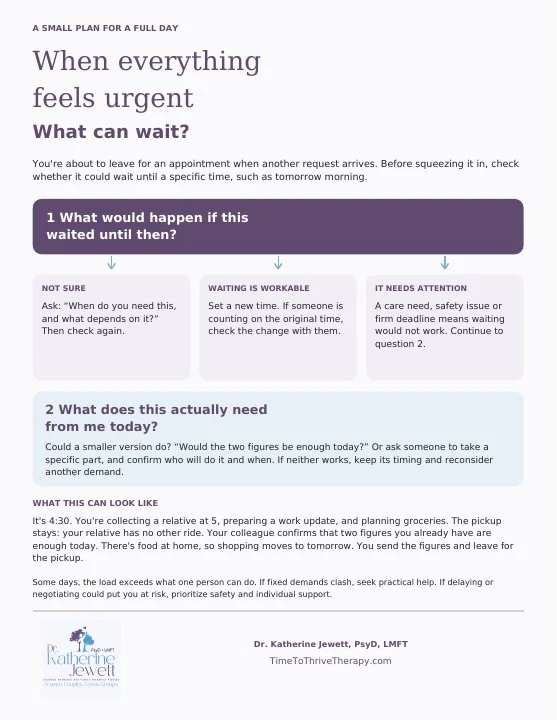
FREE PRACTICAL GUIDE
Consider what is still realistic
My What Can Wait? guide gives you a place to consider what needs attention today, what can be smaller, and where help may be needed. Use it to clarify what is genuinely possible before changing an ordinary commitment; it does not replace timely notice or agreement with the person relying on you.
Download the free What Can Wait? guide
Use paper or a notes app to think through an ordinary task. Essential care or urgent safety needs require an appropriate plan, not simply putting them off.
Renegotiate the commitment with a clear first sentence
Choose a channel likely to reach the person in time. A text may be appropriate for a small plan; an imminent commitment may need a call or a direct follow-up if the message is unread.
“I need to change what I offered for Friday. I won't be able to prepare the meal.”
Then provide the context you are comfortable sharing: “My availability has changed,” or “I underestimated what I could take on this week.” If you made an unrealistic promise, you can say so without describing yourself as unreliable in every area of life.
The Centre for Clinical Interventions emphasizes clear, respectful communication. [1] Here, the useful information is what has changed and what the other person can count on now.
Acknowledge the practical consequence
“I know you were relying on me for dinner, and this leaves you with something to rearrange. I'm sorry for changing the plan.”
That acknowledgment can stand on its own. Avoid immediately adding a list of reasons the person should not feel inconvenienced. They may understand your situation and still face a real problem.
If you do not know the impact, ask one concrete question: “What have you already arranged around my offer?” Perhaps they bought groceries, declined someone else's help, or planned to be away. Knowing that may change which alternatives are useful.
Take care not to assume that acknowledging an impact commits you to fixing everything. First understand the problem. Then decide what you can reasonably offer.
Bring a feasible alternative, when you have one
You might say, “I can order from the place we discussed, if that would work for you,” or “I can make the dish on Saturday, but I can't deliver it Friday.” Costs, dietary needs, and timing still need agreement. Do not treat a substitute as accepted because it seems equivalent to you.
If another person may help, ask them before volunteering their time or sharing private information about why the change is needed. “I'll find someone” is a new promise; make it only if you can follow through.
Sometimes there is no useful alternative you can provide. Be honest: “I don't have another arrangement to offer. I wanted to tell you now rather than leave you waiting.” That may be disappointing, and it gives the other person accurate information.
Make room for their answer
The other person might say, “That doesn't work. I needed it Friday.” You can acknowledge the mismatch: “I understand. Saturday won't solve this.” Then return to what is actually possible.
If Friday is the day they need food, Saturday may be of no use to them. You can accept that answer: “You’re right, that won’t cover Friday. I don’t have another option I can promise.” That may feel uncomfortable, but it lets them plan with accurate information instead of trying to make your substitute work.
If they are upset, listen for a concrete concern you have missed. You can address that concern without making an immediate promise under pressure. “Let me check whether I can cover that part. I'll confirm by noon” is useful only if you do check and reply.
Confirm the new agreement
End with a short summary that someone could plan around: “So I'll send the recipe tonight, and you will arrange Friday's meal. I won't be bringing food.”
If the plan is unresolved, say that too: “We haven't found a replacement. My original offer is no longer available.” Do not let a warm goodbye conceal a different understanding about who is doing what.
For commitments involving other adults, agree who will tell them. Share the changed logistics without circulating more personal context than necessary.
The broader question of reliability and realistic commitments includes being honest when an earlier plan can no longer be kept.
Learn something for the next yes
Later, consider what made the first commitment hard to assess. Did you answer before checking the calendar? Agree to a task whose size was unclear? Hope that you would have more energy than you realistically expected?
If you agreed before understanding the job, next time you might ask, “Are you asking me to cook, or to organize the whole meal?” If you answered before checking your week, try, “Let me look at what I’ve already agreed to and get back to you tomorrow.” Choose a change that addresses what happened this time; unexpected needs can still arise.
These suggestions assume ordinary, reasonably safe relationships. When a changed plan brings threats or retaliation, confidential individual support may be safer than negotiation. [2]
If the meal is this Friday and you already know you cannot provide it, the useful message is specific: “I won’t be able to prepare Friday’s dinner. I’m sorry to change the plan. Can we talk today about what you’ve already arranged?” You can begin that conversation before you have solved the replacement.
This article offers general education, not legal advice or individualized mental health care. Dialogue is illustrative, not client material.
Sources
- Source 1: Assertiveness
More support for calm and connection