
By Dr. Katherine Jewett, PsyD, LMFT | Time to Thrive Therapy
You tell your sibling that you cannot host this weekend. The conversation ends politely, but an hour later you are considering taking it back. You imagine everyone rearranging plans. You hear a familiar thought: “If I were more generous, this wouldn't be a problem.”
I would want to understand that guilt before deciding what you should do with it. It may point toward a responsibility you need to address. It may also reflect how difficult it is to disappoint someone. Sometimes both are present.
Before you send, “Actually, I’ll make it work,” ask what you are trying to put right. Did you change a plan people were relying on, speak more sharply than you intended, or simply say something your sibling did not want to hear? The answer matters because those situations call for different responses.
Understand the guilt after setting a boundary
“I am selfish” tells us how harshly you are judging yourself. It gives us very little to work with. Try describing the event without making it a conclusion about your character.
“I said I could not host.”
“I cancelled after people bought train tickets.”
“I snapped when my sibling asked whether I could reconsider.”
Those are three different situations. The first may be a reasonable limit. The second includes an existing commitment and a practical consequence. The third includes a way of speaking that you may want to repair, even if hosting remains impossible.
I'd ask: Which part is actually troubling you? That question can keep a broad feeling of guilt from turning into an obligation to change everything at once.
If the concern becomes a global judgment about your character, responding to self-critical thoughts is a related skill.
Check what you had agreed to
Look at the agreement that existed before this conversation. Had you clearly offered to host? Was someone assuming because you usually do it? Had you said you would check and respond later?
If there was a clear promise, acknowledge it accurately. “I told you I could host, and you made plans around that. I need to take responsibility for changing it.” The next step may involve notice, an apology, or finding out what disruption you can realistically reduce.
If you never agreed, you can still recognize disappointment without accepting an agreement that was not made: “I understand you were expecting our usual arrangement. I hadn't confirmed it, and I can't host this year.”
If you usually host, your sibling may have assumed you would again. You can recognize how that assumption arose and make this year’s answer clear: “I know I’ve hosted before. I can’t do it this time, so we need to make a different plan.” If you had already promised, name that too rather than treating it as an assumption.
Separate an impact from a prediction
What do you know about the other person's response? Perhaps they told you they need to find another place to stay. That is useful information. Perhaps you are imagining that they think you do not care. That interpretation may need checking rather than immediate action.
One proportionate question can help: “Is there a practical problem my change has created that we haven't discussed?” Listen to the answer without promising to solve every difficulty.
Repeatedly asking “Are you sure you're not upset?” can keep both of you focused on obtaining reassurance. Instead, identify the information that would change your next step. If nothing new is needed, you can leave some uncertainty unresolved while going about the day.
Make the correction fit what happened
Suppose you declined reasonably but sounded cutting. A specific repair might be: “I was abrupt earlier, and I'm sorry for that. I still can't host. I want to answer you more respectfully.”
Suppose you gave a late answer that left someone waiting. You might apologize for the delay and give a clear answer now. Suppose you misunderstood the request and have learned that a smaller task would genuinely fit. You can reconsider because the information changed.
The Centre for Clinical Interventions frames assertiveness around respect for one's own needs and for others. [1] In the hosting conversation, that means you can apologize for snapping and answer the question more respectfully while still explaining that you cannot host. The apology addresses how you spoke; a new yes would create a commitment you may still be unable to keep.
Ask what a new yes would require
Before reversing your answer, picture the actual commitment. What time, money, effort, or rearrangement would it involve? Who else would be affected? Would you be agreeing to something you still cannot provide?
“I could manage it somehow” may conceal another person's unasked-for work or a responsibility that would go unattended. Be as concrete about the proposed yes as you were about the original no.
If a revised offer is realistic, name it: “I can't host overnight. I could join you for lunch.” If it is not realistic, guilt has not created the missing capacity.
A recurring pattern of family overfunctioning may help explain why reconsidering one answer can feel so consequential.
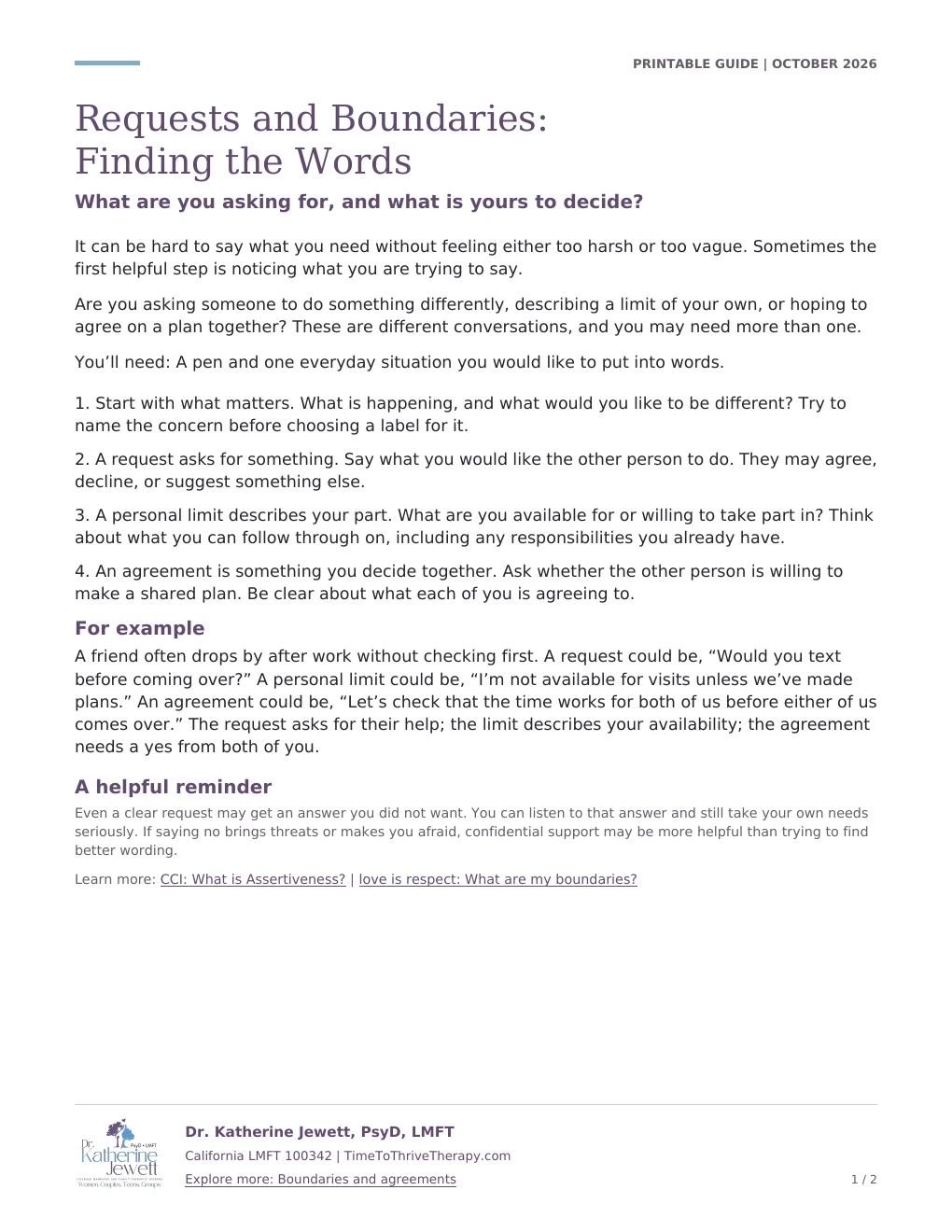
FREE PRINTABLE GUIDE
Review the boundary you’re reconsidering
If you’re unsure whether to change your answer, it may help to put the request, your limit, and any existing agreement into separate sentences. This guide gives you space to check your responsibilities and find words you can stand behind.
A two-page printable guide. You’ll need: A pen and one everyday situation you would like to put into words.
Give the discomfort somewhere else to go
Once you have checked the facts, you may still feel guilty. You do not have to settle that feeling by sending another message. You might write the concern down privately, speak with a trusted person, or notice the expectation underneath it: “I believe being dependable means never disappointing anyone.”
Is that expectation workable in an actual relationship between people with limits? What would you ask of a friend facing the same situation? These are questions for reflection, not a test with one correct answer.
If guilt repeatedly drives choices that harm your wellbeing or makes daily life difficult, consider exploring the pattern with a qualified professional. If another person uses threats or punishment to enforce compliance, seek confidential support focused on safety rather than joint negotiation. [2]
You might end up saying, “I’m sorry I left it so late to tell you. I still can’t host, and I understand that you need to change your plans.” If there is something practical you can do about the disruption, offer it specifically. If there is not, give a clear answer rather than another yes you are already worried you cannot keep.
This article offers general education, not individualized mental health care. Dialogue is illustrative, not client material.
Sources
- Source 1: What Is Assertiveness?
More support for calm and connection