By Dr. Katherine Jewett, PsyD, LMFT | Time to Thrive Therapy
A friend asks whether you can help with an event. You already know that you cannot take it on. Still, you begin composing a message about your work, your family, the appointments you have postponed, and how little sleep you got last night.
By the time you finish, your no is hard to find. You may also have shared details you wanted to keep private.
I’d be curious about what you hope the explanation will accomplish. If you are hoping your friend will agree that you have a good enough reason, every sentence can seem to need another. You may want to be understood and still decide that your friend does not need the details of your sleep or family life to know whether you can help.
Say no clearly before deciding how much to explain
Start privately: Is your answer no, yes to a smaller part, or genuinely undecided?
If you are undecided, ask for time you can actually use: “I need to check a few things. I'll let you know tomorrow.” Then follow through. If you already know you cannot help, an indefinite “maybe” may leave both of you planning around an option that does not exist.
The Centre for Clinical Interventions describes assertiveness as communicating directly while respecting other people. [1] In this situation, that can mean giving the person a usable answer and treating your own availability as relevant information.
Try writing the answer first: “I can't help with the event this time.” You can decide what else belongs after you can see that sentence clearly.
If the difficulty sits within family expectations around saying no, the broader pattern may matter as much as the wording.
FREE PRACTICAL GUIDE
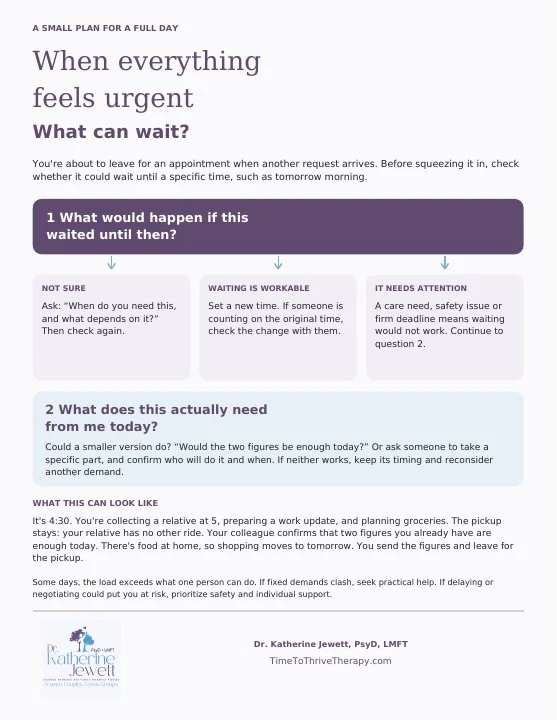
Check what you have room for
If you’re still deciding, it may help to look at what’s already on your plate. My What Can Wait? guide can help you think through what needs your attention today and what a new request would mean for your existing commitments.
Download the free What Can Wait? guide
A one-page guide to use with paper or a notes app.
Add a reason when it serves the conversation
A brief explanation can express care or clarify a practical misunderstanding. It does not need to become a complete account of your circumstances.
“I'm keeping that weekend free, so I won't be able to help.”
“I don't have room for another commitment this month.”
“Thank you for thinking of me. I'm going to pass.”
Which sounds like you? A sentence you can say naturally is more useful than a polished line that makes you feel as though you are performing someone else's personality.
You might willingly give a close friend more context. The question is whether you are choosing to share it. Notice when each sentence becomes another attempt to make disagreement impossible. No amount of detail can guarantee that someone will feel pleased with your answer.
Leave out the excuse you would have to maintain
It can be tempting to invent an appointment because “I want a quiet evening” feels insufficient. Then the friend suggests another time, or asks how the appointment went, and the simple request now carries a second problem.
An honest, limited response gives you less to manage later. “I'm not available” can be accurate without describing every part of your evening. You do not need to call rest an emergency or produce a more impressive competing obligation.
This guidance concerns ordinary requests that you are free to decline. A job duty, an existing caregiving responsibility, or a formal agreement may require a discussion about coverage or obligations. Check what you have actually committed to before treating the situation as a first-time invitation.
Offer an alternative only if you mean it
Sometimes you want to help in a smaller way: “I can't work at the event. I can proofread the invitation on Tuesday.” That is a separate commitment. Check it with the same care you would give the original request.
You can also decline without offering a replacement person, a different date, or another task. Ask yourself whether the alternative reflects genuine willingness or is an immediate attempt to make the uncomfortable feeling stop.
If you offer something, make its size clear. “I can look at one page” is easier to understand than “I'll help however I can.” Leave room for the other person to say that your offer does not meet the need.
Answer a follow-up without reopening every detail
A question may be a request for clarification rather than an argument. You can respond to the actual question:
“Would it help if you came for only an hour?”
“Thanks for offering that option. I still won't be able to participate.”
If they ask why, you can decide whether to add information: “It's a personal decision, and I'm keeping the details private.” If they say they are disappointed, you can acknowledge that: “I understand you were hoping I could be there.”
Acknowledgment does not require you to make a new offer. You can care about how the answer lands while keeping the answer clear.
Let the message end
After sending it, you may want to add another paragraph. Before doing so, check whether anything important was missing. Did you leave the timing unclear? Accidentally imply that you might come? Those are useful reasons to clarify.
If the answer was clear, set the message aside and return to what you were doing. When you want to add, “I hope you’re not upset with me,” ask what has changed since you sent it. If there is no new information, you may be trying to relieve the discomfort of waiting for a response. That is worth noticing before you send another explanation.
These examples assume it is reasonably safe to decline. If saying no brings threats, surveillance, or retaliation, prioritize confidential safety-oriented support rather than practicing firmer wording. [2]
Your finished message might be only, “Thanks for asking. I can’t help with the event this time.” If that feels abrupt in your friendship, add something you genuinely mean, such as, “I hope it goes well.” Then read it once for anything the person actually needs to plan, rather than for a reason convincing enough to prevent disappointment.
This article offers general education, not individualized mental health care. Dialogue is illustrative, not client material.
Sources
- Source 1: Assertiveness
More support for calm and connection