By Dr. Katherine Jewett, PsyD, LMFT | Time to Thrive Therapy
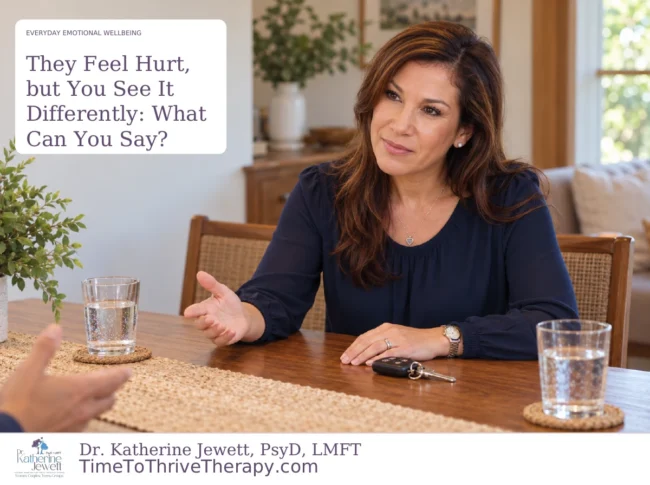
Your partner says, “You were embarrassed by me at dinner.” You can see they are hurt, and you do not agree with their explanation. You were distracted by a message about tomorrow's work schedule. Now you are worried that acknowledging their feelings will sound like admitting to an intention you did not have.
You do not need to choose between denying their hurt and confirming every part of their account. There is room to understand the experience, clarify what you know, and keep a different view. This is sometimes called validating feelings without agreeing: recognizing the emotional experience without endorsing every explanation or action.
I would want to slow the exchange enough to find out what, specifically, needs recognition. Was it the moment you looked away? A joke you made? The fact that they tried twice to get your attention?
Separate the feeling from the explanation
“I felt embarrassed” describes an experience. “You wanted to embarrass me” adds an explanation of another person's intention. The two may feel inseparable in a painful moment, but they invite different responses.
You could begin with, “I didn’t realize you felt embarrassed. Can you tell me what happened from your side?” Give them time to answer before explaining your intention. If you are only waiting for a chance to prove that they misunderstood, you may miss the part of the evening they need you to hear.
Perhaps they say, “I asked you a question, and you looked at your phone while everyone waited.” That gives you something concrete to address. You may have been preoccupied, and looking away still left them in an uncomfortable moment.
You could respond, “I did look at my phone while you were speaking. I can understand why that felt dismissive. I was checking the schedule message; I was not trying to embarrass you.” Each sentence addresses a different part of the event.
Recognize only what you understand
You do not have to say, “That makes complete sense,” when you are still confused. A tentative reflection can be more honest: “It sounds as though you felt left alone in that conversation. Am I getting that?”
The correction matters. They may say, “I wasn't left alone. I felt foolish.” Stay with what they tell you rather than defending the accuracy of your first guess.
The Centre for Clinical Interventions describes empathic assertion as recognizing another person's feelings or needs while also expressing your own position. [1] At dinner, that could mean staying with their account long enough to understand why they felt foolish, then explaining the message you were reading. You can do both without pretending you meant to embarrass them.
Sometimes a simple statement is enough: “I can hear how disappointed you are.” You do not have to invent an explanation about their childhood, attachment style, or nervous system to show that you are listening.
For a wider discussion of listening during relationship repair, consider how reflection can sit alongside an honest difference in perspective.
State your difference without withdrawing care
Consider an everyday disagreement about lending a friend a car. One person feels worried about letting the friend down; the other does not want to lend a car they both rely on.
“I understand that saying no feels difficult because they have helped us before. I am still not comfortable lending the car. Can we discuss another way to help?”
The feeling is acknowledged, the decision remains visible, and another question becomes possible. This is different from saying, “I understand, so I suppose we have to do it.” That response turns emotional recognition into agreement the speaker does not actually want to give.
It is also different from, “There is no reason to feel guilty.” You may see other options without deciding whether someone is allowed to have the feeling they have.
Check whether you owe a correction
Understanding is not a technique for avoiding responsibility. If the other person describes something you did, consider it directly. Did you interrupt? Share private information? Agree to a plan and then fail to communicate a change?
“I did not mean it that way” may explain your intention; it does not answer every question about your action. You can say, “I did share that story without asking. I am sorry. I disagree that I wanted to hurt you, and I am responsible for sharing it.”
Notice what happens when you hear something you disagree with. Do you stop listening as soon as you can correct one detail? You might need to say, “I remember that part differently. I also want to understand what happened after I shared the story.” That lets you keep the disagreement without losing the part you do need to address.
Allow some disagreement to remain
You may finish a conversation without agreeing about whether a remark was funny, whether an invitation was reasonable, or how much notice a plan needs. Ask what must be decided to move forward.
“We see the joke differently. I understand you do not want me to make it about you again, and I can respect that.” Or, “We have different ideas about a good weekend. We still need to decide what we are each committing to.”
Not every difference requires a winner. Some do require a practical decision, and unresolved differences can also be important information about a relationship. Listening should help you see that information more clearly rather than pressure you to overlook it.
Respect for feelings does not excuse intimidation, coercion, or harmful behavior. If disagreement brings threats or retaliation, seek confidential individual safety support rather than testing these examples together. [2]
For an ordinary safe disagreement, you might return to the dinner conversation by saying, “I understand now that you were waiting for me to answer while everyone looked at you. I’m sorry I left you in that position. I was distracted by the message. Next time I need to check something, I’ll tell you rather than just turning away.” Use the parts you can say honestly; do not promise a change you are unwilling to make.
This article offers general education, not individualized mental health care. All situations and dialogue are invented illustrations, not client stories.
FREE REFLECTION WORKSHEET
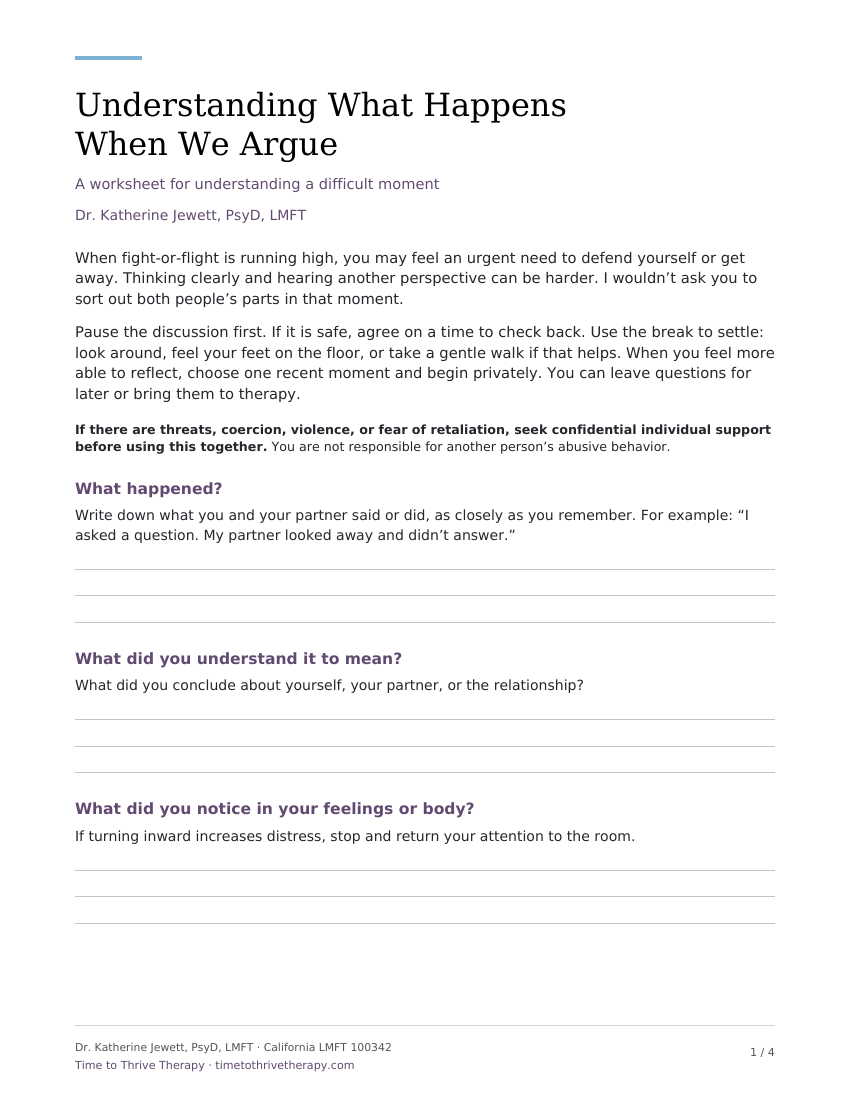
Understanding What Happens When We Argue
Use this four-page worksheet to separate what happened from what you understood it to mean, reflect on your own response, and leave room to hear what your partner actually says. Each person names their own part rather than deciding for the other.
Download the free argument reflection PDF
Read on screen and use a notebook for your responses, or print the pages and use a pen or pencil. Begin privately with one recent moment when you feel able to reflect. Leave questions for later if you need to.
If there are threats, coercion, violence, or fear of retaliation, seek confidential individual support before using this together.
Sources
- Source 2: Healthy Relationships
More support for calm and connection
- How to Prepare for a Difficult Conversation With Your Partner
- Still Disagree After an Argument? How to Make a Decision Together
- How to Ask for Help Without Explaining Everything
- Why Do I Feel Disconnected From My Body?
- Don’t Know What You’re Feeling? How to Find Words for It
- How to Unwind When You’re Still Thinking About Work
- When Coping Isn’t Enough: How to Ask for Mental Health Support
- Your Partner Changes Plans Without Telling You: How to Ask for Updates
- They Apologized, but You Still Need Time: What to Say