
By Dr. Katherine Jewett, PsyD, LMFT | Time to Thrive Therapy
Someone says, “I'm sorry.” You believe they mean it. You may even feel relieved. Then they ask, “Are we okay?” and you realize you do not have a simple answer.
You are still hurt. You want to understand whether something will change. Or you need a quiet evening before you can think about what comes next.
“I believe you’re sorry” may be true. So may “I’m still hurt” or “I need to know what happens next.” If “Are we okay?” seems to require one answer to all of that, it may help to say which part you can answer now.
Find the response that is true today
“Thank you for apologizing” can acknowledge that you heard the apology. It does not need to stand in for a decision about trust, closeness, or the future of the relationship.
You might say, “I appreciate that you named what happened. I am still upset, and I am not ready to talk through the rest tonight.”
If you are unsure what you feel, you can say that too: “I heard you. I need some time to understand my response.” You do not have to choose between immediate warmth and a definitive rejection.
Words such as acceptance and forgiveness can mean different things to different people. If someone asks whether you “accept” an apology, it may help to clarify: “I believe you are sorry. I have not decided what I need before we make plans together again.” That gives a more accurate account than a word whose meaning neither of you has checked.
Ask what remains unfinished
An apology may address one part of an event while leaving another part unresolved. Imagine a friend cancels a shared trip after you have paid a nonrefundable cost. They apologize for the late notice. You appreciate it, and there is still a practical question about the expense.
You could say, “Thank you. I also need us to discuss the cost I incurred. Could we look at the details on Saturday?” An emotional acknowledgment does not settle an unaddressed practical matter.
In another situation, the practical repair may be clear but you are still wondering whether a repeated behavior will change. “I understand your plan to check with me before sharing personal news. I am going to be more careful about what I share for now.”
With the trip, you may be ready to thank your friend for apologizing and discuss the expense, while still feeling unsure about traveling together again. You do not have to settle all three in one conversation. Start with the part that needs an answer soon, such as how to address the expense.
If you are considering what repair would involve, relationship repair beyond an apology is a broader question.
Make “time” understandable without promising a feeling
If it is safe and you want to continue the conversation, tell the other person what taking time means in practice. Perhaps you do not want repeated apology messages tonight. Perhaps you can handle logistics by text but do not want a long phone call.
“I will reply about the ride tomorrow. I do not want to discuss the argument by text tonight.”
You can offer a check-in without promising to feel differently by then: “Let's check in on Sunday. I cannot promise I will have a final answer.” The appointment is for a conversation, not a deadline for forgiveness.
Consider existing responsibilities when making the arrangement. If you share childcare or another essential task, separate necessary coordination from the emotional discussion. A request for space should not leave another person guessing about who is picking someone up or covering an agreed responsibility.
Notice when reassurance replaces repair
Sometimes the person apologizing becomes distressed: “I feel terrible. You must think I'm an awful person.” You may care about their distress and still want the original impact to remain part of the conversation.
You might say, “I know this is hard to hear. I’m still trying to tell you what upset me, and I want to finish that before we talk about whether everything is okay.” If you are too tired to continue, you can say, “I need to stop for tonight. I still want us to discuss this when we talk on Sunday.”
You are allowed to choose your level of closeness and privacy. Love is respect describes boundaries as connected to your own comfort and needs, and emphasizes that changes should be freely chosen rather than pressured. [1] An apology does not decide those choices for you.
For repeated promises, observable follow-through may matter more than another reassuring exchange.
Leave room for more than one outcome
Time may help you see a workable next step. You might want another conversation, a smaller commitment, or a chance to observe follow-through. You might decide you need distance. You might still be unsure.
I would pay attention to whether the next step matches what you actually know. If this is a limited mistake in an otherwise respectful relationship, you may choose a modest repair. If the same harm keeps happening, the repetition belongs in your decision even when each apology sounds sincere.
You do not need to test the other person with hidden rules. Where safe, name the action or information that matters. You also do not have to promise that a particular action will restore trust on demand.
If there are threats, coercion, or fear of retaliation, prioritize confidential individual support over a shared repair conversation. [2]
If “Are we okay?” leaves you stuck, you might say, “I’m glad we talked, and I’m still hurt. I’d like a quiet evening. Can we talk again tomorrow?” If you don’t know what you’ll want tomorrow, say that too. You can decide when to talk again before you know what you’ll decide about the relationship.
This article offers general education, not individualized mental health care. All situations and dialogue are invented illustrations, not client stories.
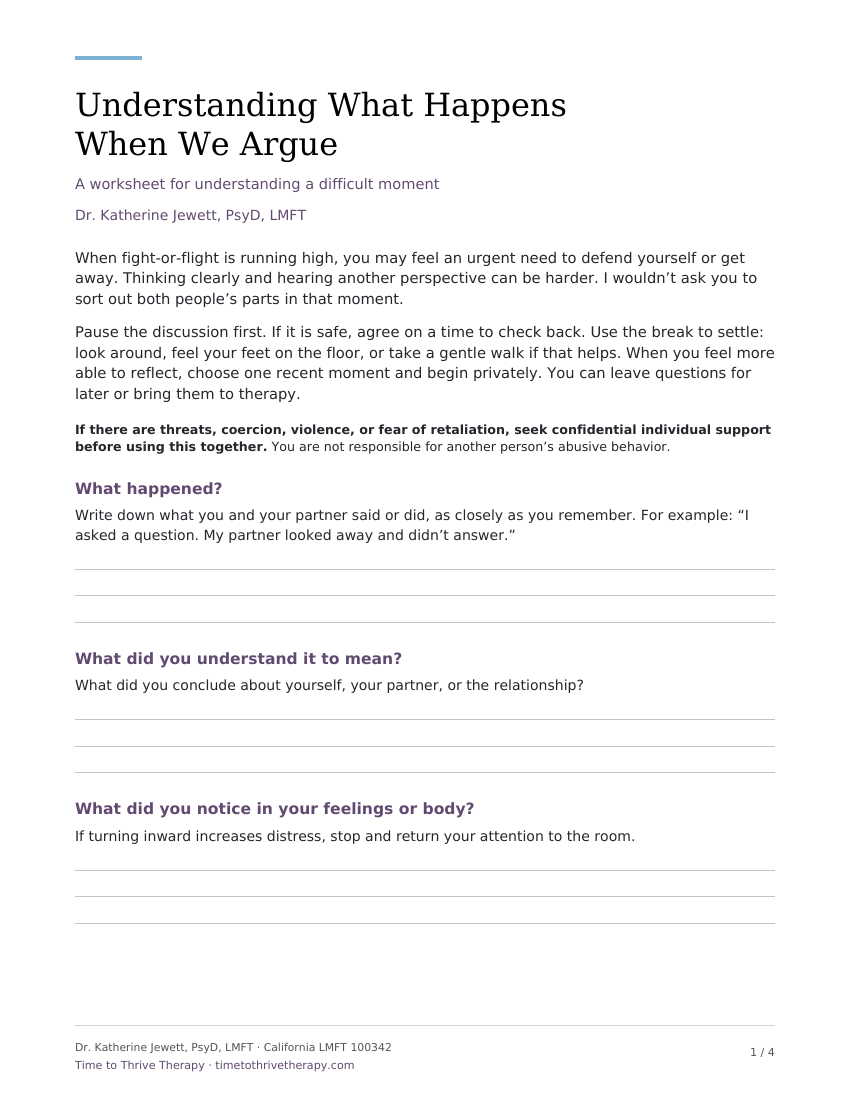
FREE REFLECTION WORKSHEET
Understanding What Happens When We Argue
Start privately with what happened, what you felt or needed, and what you want to understand before choosing a next step. This four-page worksheet leaves room to return to questions later; you do not have to begin a joint conversation.
Download the free argument reflection PDF
Read on screen and use a notebook for your responses, or print the pages and use a pen or pencil. Begin privately with one recent moment when you feel able to reflect. Leave questions for later if you need to.
If there are threats, coercion, violence, or fear of retaliation, seek confidential individual support before using this together.
Sources
- Source 1: What Are My Boundaries?
More support for calm and connection
- How to Prepare for a Difficult Conversation With Your Partner
- Still Disagree After an Argument? How to Make a Decision Together
- How to Ask for Help Without Explaining Everything
- Why Do I Feel Disconnected From My Body?
- Don’t Know What You’re Feeling? How to Find Words for It
- How to Unwind When You’re Still Thinking About Work
- When Coping Isn’t Enough: How to Ask for Mental Health Support
- Your Partner Changes Plans Without Telling You: How to Ask for Updates
- They Feel Hurt, but You See It Differently: What Can You Say?