By Dr. Katherine Jewett, PsyD, LMFT | Time to Thrive Therapy
Your friend usually replies quickly. Today, several hours have passed. You look again at the message you sent and wonder whether it sounded demanding. Then you remember a moment from your last conversation. Perhaps that was the problem.
By the time you reach for your phone again, the possibility has become a conclusion: “They're upset with me.”
When you think someone is upset with you, waiting for a reply can become painful very quickly. What happened between you before the silence began? Did they say something that concerns you, or are you trying to work out their feelings from an unanswered message?
Check the evidence when you think someone is upset with you
Start with a sentence another person could confirm: “I sent a message this morning and haven't received a reply.”
Then write the explanation you have added: “They're upset because I asked for too much.”
The second sentence may be possible. It is still different from the first. Keeping that distinction visible creates room to decide what to do without treating every uncomfortable prediction as settled fact.
NHS guidance on reframing thoughts recommends examining the evidence and considering other explanations. It also notes that changing a thought is not always possible. [1] You do not have to replace your concern with a cheerful certainty that everything is fine.
Ask what made this explanation convincing
Maybe the message was ordinary, but silence feels particularly difficult today. Maybe your friend sounded irritated yesterday. Maybe you did make a request that deserves a follow-up conversation.
These are different situations. Rather than dismissing yourself as “overthinking,” ask what information you are using.
Did the person say they were upset? Is there a specific event to discuss? Are you relying mainly on response time, punctuation, or a feeling of dread? Has the usual pattern actually changed, or are you checking more frequently than usual?
“You sounded frustrated when we hung up” gives you an interaction to ask about. “You used a period instead of an exclamation point” may tell you more about how closely you are reading the message. Either can feel unsettling; they give you different reasons for deciding whether to check in.
If the assumption quickly becomes a judgment about your worth, responding to a harsh inner critic is a related question.
Consider alternatives that are genuinely plausible
A delayed reply can have several explanations. Someone may be working, caring for another person, uncertain how to answer, or simply unavailable. They may also be irritated. Listing possibilities does not tell you which one is true.
An accurate sentence might be, “I haven't heard back, and I don't know why.” You can add the emotional part: “The uncertainty is making me anxious.”
Notice how that differs from “There is definitely nothing wrong.” The first account leaves space for new information. The second asks you to be certain in the opposite direction.
Keep this brief. You do not need twenty alternative explanations or a careful probability for each. If the exercise becomes another way to search for complete reassurance, put it down and return to the decision that actually needs making.
Decide whether a check-in has a purpose
Before sending another message, ask what you need to learn or communicate. Are you confirming tonight's plans? Responding to something you actually said? Or asking the other person to remove a feeling you cannot currently settle?
For a practical question, use a practical message: “Are we still meeting at six? Please let me know by four so I can plan.”
If you have a specific concern about an interaction, name it without deciding the other person's feelings for them: “I interrupted you several times yesterday. I'm sorry. I wanted to acknowledge that.”
When a relationship concern genuinely needs discussion, you might ask once: “I've been wondering about our conversation yesterday. Is there anything you'd like to talk through?” Leave room for their answer and their timing.
A proportionate check-in is different from sending several versions of “Are you sure you're not mad?” An answer may not remove all uncertainty, and a relationship cannot always supply certainty on demand.
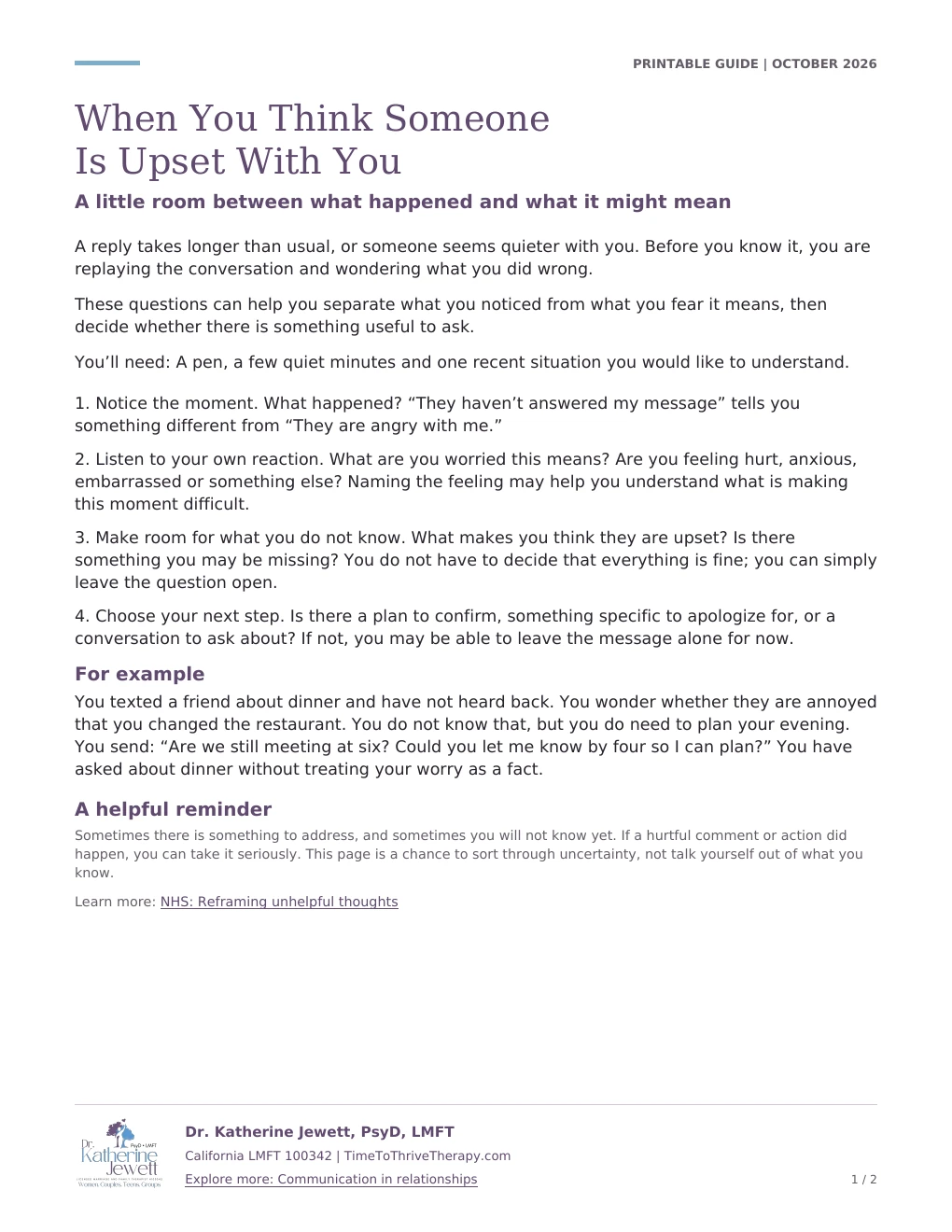
FREE PRINTABLE GUIDE
When You Think Someone Is Upset With You
These questions can help you separate what you noticed from what you fear it means, then decide whether there is something useful to ask.
A two-page printable guide. You’ll need: A pen, a few quiet minutes and one recent situation you would like to understand.
Respond to the information you receive
If the person says they were busy, you can take that response into account without testing it repeatedly. If they say they were hurt, you now have something concrete to understand. Ask about the specific interaction and consider your responsibility for it.
If they do not reply, decide what you need for your own planning. You might make another arrangement or revisit the conversation later. An unanswered message leaves an unanswered question; it does not automatically establish your worst explanation.
Over time, a pattern of unreliability or unresolved tension may warrant a broader conversation. That is different from treating one delayed reply as a complete account of the relationship.
Keep the exercise within its limits
This reflection is for ordinary uncertainty in reasonably safe relationships. It is not an instruction to reinterpret threats, intimidation, or documented mistreatment as a misunderstanding. If you fear retaliation, prioritize confidential support and safety rather than practicing a check-in.
If you repeatedly feel driven to review messages, ask for reassurance, or avoid people because of these fears, discuss the pattern with a mental health professional. [2] General thought-checking advice may need to be adapted to your situation, especially when checking itself has become difficult to stop.
If your friend later replies, “Sorry, meetings all day. Six still works,” you might answer, “Great, see you then.” You may still feel unsettled. That feeling does not require another round of asking whether they are angry; you can let the plan stand and notice whether this is a familiar difficulty you want help understanding.
This article offers general education. Examples are invented illustrations, not client material or a personalized treatment plan.
Sources
- Source 1: Reframing unhelpful thoughts
- Source 2: I'm So Stressed Out!