
By Dr. Katherine Jewett, PsyD, LMFT | Time to Thrive Therapy
You agreed to take a break. Now the agreed time is approaching, and you are unsure how to begin again. Do you apologize first? Ask whether the other person is still upset? Pretend the interruption did not happen?
The return can feel awkward because the original concern is still there. A pause may have given you room to think, eat, finish a responsibility, or stop speaking in ways you regret. It has not necessarily settled the disagreement.
When restarting a conversation after an argument, I would begin by asking what made you stop and what has changed since then. Are you ready to hear each other, or mainly feeling pressure to get the disagreement over with? That can help you decide whether to return to the original issue or first address how the conversation went.
Restart the conversation with the plan you made
If you agreed to talk after dinner, take responsibility for checking in then. You might say, “We said we would come back to the conversation after dinner. Is now still workable?” Avoid waiting silently for the other person to prove they care by bringing it up.
If the timing has changed, name that as soon as you can. “The appointment ran late. I can talk at eight, or tomorrow morning before work. Which is possible for you?” A changed plan needs a new proposal; “later” can leave both people wondering what happens next.
There is no universal number of minutes that makes someone ready. In guidance written for families affected by post-traumatic stress disorder (PTSD), the VA includes agreeing on a return time as part of taking a break. That is a useful planning principle, not a diagnosis or a stopwatch for every relationship. [1]
If no return was arranged, you can repair that part: “I left without saying when I would be ready to talk. I want to come back to the question about Saturday. Could we find a time tonight?”
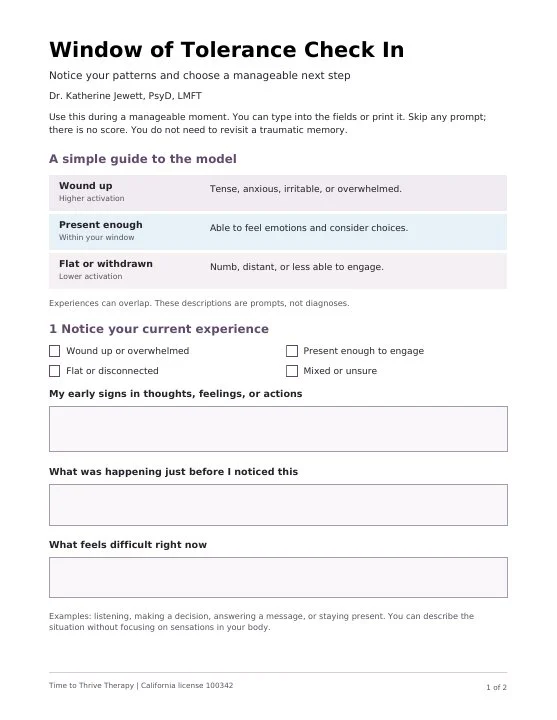
FREE FILLABLE CHECK-IN
Try a brief check in
Before returning to a safe conversation, you might use my Window of Tolerance Check In to notice what is difficult and what support you need. Use it to describe your own experience, not to label your partner or decide whose concern matters. Completing it is not a condition for being heard.
Download the free check-in PDF
View instructions and supplies
Two pages, fillable or printable. Use a manageable everyday example, skip any prompt, and keep your completed copy private. Breathing is optional.
Identify the unfinished issue
Before restarting, finish this sentence privately: “The decision or concern we have not addressed is…”
Perhaps you still need to decide who will attend an appointment. Perhaps you need the other person to understand why a comment hurt. Those are different conversations. Confusing them can leave one person searching for a plan while the other is asking to be heard.
Try making the purpose explicit: “I would like you to understand what bothered me about the comment. We do not have to decide next month's plans tonight.” Or, “We have heard each other's concerns. We still need a practical answer about tomorrow.”
If there are several issues, say what you want to return to later: “I do want to talk about the holiday plans. Tonight we need to decide who can be at the appointment tomorrow. Could we talk about the holidays on Sunday?” A short note can help you remember both conversations, if keeping notes is safe in your situation.
If the same issue returns repeatedly, understanding a recurring argument may be useful background for a separate conversation.
Start without testing the other person
“Are you finally ready to listen?” contains a question, but it also opens another argument. A more usable beginning describes your intention and, when appropriate, your part in what happened.
“I interrupted you earlier. I want to hear the rest. Then I would like a turn to explain what I need.”
You can acknowledge an interruption without accepting a claim you believe is inaccurate. If you disagree about what was promised, say so clearly after hearing the account: “I remember offering a ride on Friday. You remember that as a weekly arrangement. We need to clarify that.”
I would be interested in the point where your understandings separated. The aim is to learn enough to address that difference, rather than build a more complete case against each other.
If you need to acknowledge an interruption or hurtful response, taking responsibility during relationship repair offers a broader companion.
Work through one real decision
Imagine two adults disagreeing about a weekend invitation. One already replied yes for both; the other had planned to stay home. After the pause, “You never consider me” may express genuine hurt, but it does not yet identify what needs to happen with this invitation.
A more focused opening could be: “I was upset that you answered for me. I want us to check with each other before accepting invitations together. For this Saturday, I am not available. What do we need to tell the host?”
The other person can take responsibility for replying without treating the invitation as something that must now be accepted. They can also discuss their disappointment separately. This does not make the disagreement painless; it makes the immediate question clearer.
Close with what is settled and what is not
Before ending, say the outcome in ordinary words: “You will let the host know tomorrow that I cannot come. We still disagree about how much notice we need for weekend plans. We will talk about that on Sunday.”
Sometimes the outcome is simply better understanding. You can say, “I understand more about why that mattered. I have not decided what I can offer.” Do not turn a tentative idea into an agreement just to produce a reassuring ending.
If returning repeatedly becomes impossible, consider what keeps getting in the way. Is the time unrealistic? Does the discussion keep expanding? Is one person declining any conversation about the concern? These possibilities call for different responses, and individual professional support may help you examine them.
These suggestions assume disagreement is safe. Threats, coercion, or retaliation call for confidential individual safety support, rather than a joint communication exercise. [2]
You might end with, “I understand more about why you were hurt. I still need time to think about what you’re asking. Can we come back to that on Sunday?” You have not promised an answer you cannot yet give, and you have offered something more useful than “We’ll talk later.”
This article offers general education, not individualized mental health care. All situations and dialogue are invented illustrations, not client stories.
Sources
- Source 1: Helping a Family Member Who Has PTSD
More support for calm and connection