
By Dr. Katherine Jewett, PsyD, LMFT | Time to Thrive Therapy
You have tried the advice. You have taken breaks when you could, talked with someone, changed a routine, or read another article. Some things help for a while. The difficulty is still taking up more of your life than you want.
Then another question appears: “Is this serious enough to ask for help?” Preparing to ask for professional support can begin with one example of what has become hard.
You do not need a diagnosis, a complete explanation, or evidence that you have exhausted every coping strategy before starting a professional conversation. You can begin with what is happening and the part you would like help understanding.
Look at the cost of getting through the day
People sometimes evaluate their difficulty by what they are still accomplishing. “I'm going to work.” “The children are cared for.” “I haven't missed a deadline.” Those facts matter, but they are not the whole picture.
What is it taking to keep those things going? Have you stopped seeing friends, lost interest in activities, or spent much of your evening trying to recover enough for tomorrow? Is concentration harder? Are you sleeping differently? Are you avoiding situations you used to manage?
You can describe those effects without deciding what they mean medically. NIMH recommends professional help for severe or distressing symptoms that persist, and identifies changes in daily activities, sleep, interest, and concentration as reasons for attention. Its two-week example is not a requirement to wait when you are concerned. [1]
Prepare a short account for your first professional-support conversation
Write a few sentences you could read from at an appointment. Include what you notice, roughly when it began, and what it affects.
“I've been worrying most evenings for about a month. I spend a long time reviewing conversations and have trouble falling asleep. I'd like help understanding the pattern.”
Or, “I've felt flat and unusually tired. I can work, but I haven't had much interest in anything afterward. I'm not sure when it started.”
An approximate account is enough. You can say what you do not know. If finding words is difficult, begin with that: “I keep minimizing this when someone asks me about it. I wrote a few notes because I want to explain it more accurately.”
Choose a starting point you can access
A primary care professional can be a useful starting point, particularly when symptoms are new, involve physical changes, or may have several explanations. A mental health professional can discuss an assessment and whether their approach fits your concerns. NIMH notes that medical conditions can contribute to changes in mood or concentration, so physical health may need consideration too. [2]
You do not have to identify the perfect specialty before making an initial inquiry. Ask whether the professional works with the concern you describe and what they recommend if they are not an appropriate fit.
If practical arrangements are the main obstacle, name them early. You may need evening appointments, an accessible setting, language support, a certain payment arrangement, or a private place for remote visits. Ask what is available rather than assuming a website or directory has answered every detail.
If anxiety is your main concern, the practice’s information about therapy for anxiety can be a starting point for questions about fit.
Bring questions that matter to you
Before a first appointment, choose a few questions you want answered. You could ask how the clinician would assess your concerns, what approaches they might consider, and how you would decide together whether the work is helping.
You might also want to know about fees, insurance, session format, availability, and confidentiality and its limits. NIMH recommends discussing a therapist's experience, approach, goals, and practical arrangements. [2]
There is room to express preferences without knowing every treatment term. “I'd like help with something practical, but I also want to understand why this keeps happening” is useful information. So is, “I have tried this kind of exercise before and found it uncomfortable.”
A useful first conversation should make the next step clearer. It does not have to produce an immediate explanation for everything.
Mention what you have tried without grading yourself
Tell the clinician what you found helpful, ineffective, or difficult. Include relevant current care and bring information about medications, supplements, health changes, and major stressors as appropriate. NIMH's appointment guidance recommends preparing these details and questions in advance. [3]
If you stopped an exercise because it increased distress, say so. If cost or scheduling prevented consistency, include that context. “It didn't help” may need a more specific conversation, but it is not a confession that you did treatment incorrectly.
You could say, “I’m not sure I understand how this would help. Could you walk me through it?” Or, “I can’t manage that between appointments. What could we change?” A clinician needs to know about those difficulties when you are deciding what to try together.
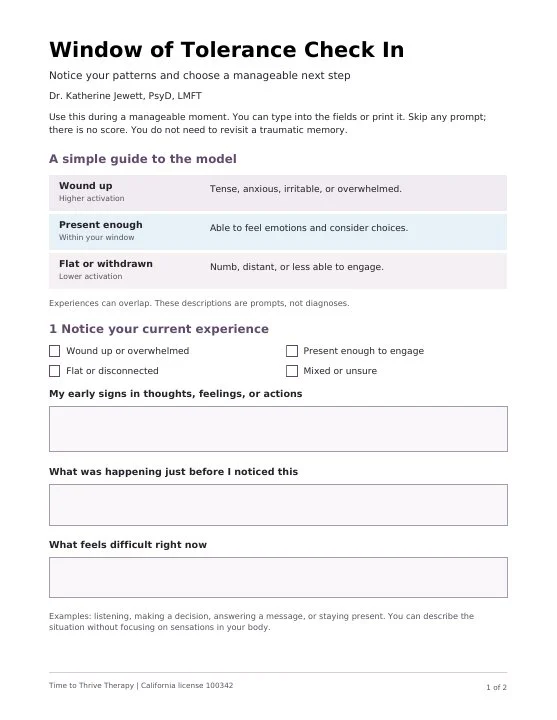
FREE FILLABLE CHECK-IN
Put your observations on one page
My Window of Tolerance Check In gives you space to note what you notice, what has become difficult, and what support might help. Those notes can be a starting point for a professional-support conversation, without needing to decide on a diagnosis yourself.
Download the free check-in PDF
View instructions and supplies
Two pages, fillable or printable. Use a manageable everyday example, skip any prompt, and keep your completed copy private. Breathing is optional.
Take one step, with room for what comes next
The next step might be contacting a primary care office, asking a prospective therapist about fit, or requesting an appointment with someone you already see. A brief inquiry can be enough: “I'm looking for help with ongoing worry that is affecting sleep. Are you accepting inquiries, and what is the process for an initial appointment?”
If you cannot stay safe or face immediate danger, seek emergency help now rather than waiting for a routine response. Ordinary appointment forms and voicemail are not emergency care.
For a nonurgent concern, choose the first contact and write your short account. You do not have to know the full path before asking someone qualified to help you work out the next part.
This article offers general education, not individualized assessment or treatment. Examples are illustrative, not client histories.
Sources
- Source 1: Caring for Your Mental Health
- Source 2: Psychotherapies
More support for calm and connection
- How to Prepare for a Difficult Conversation With Your Partner
- Still Disagree After an Argument? How to Make a Decision Together
- How to Ask for Help Without Explaining Everything
- Why Do I Feel Disconnected From My Body?
- Don’t Know What You’re Feeling? How to Find Words for It
- How to Unwind When You’re Still Thinking About Work