 Building Trust and Connection
You can love each other and still miss each other.
Some nights you get through dinner, the dishes, and tomorrow’s plans before you realize you never really talked. You miss laughing together. You miss knowing what’s on each other’s mind.
Building Trust & Connection is a 10-week, self-guided video course for couples. Learn how to notice when your partner reaches for you, ask for what you need, and find your way back after a hard conversation.
Relationship education for couples · Check back for launch details

What could sound different
between you?
Catch the invitation you almost missed.
Hear the wish for company inside “Come look at this.” If you’re busy, offer a time you can keep and be the one who comes back.
Make a promise you can both count on.
Turn “I’ll try to get home earlier” into a plan you both understand, including when you’ll send a heads-up if work runs late.
Take a break you can trust.
Find the words to say you’re overwhelmed, agree on a time to return, and know whose job it is to restart the conversation.
Give an apology that reaches the hurt.
Name what you did, show that you understand its impact, and offer a specific way to make amends. Give your partner room to say what still hurts.
“Can we try that
moment again?”
 Dev and Asha · An imagined example from the course
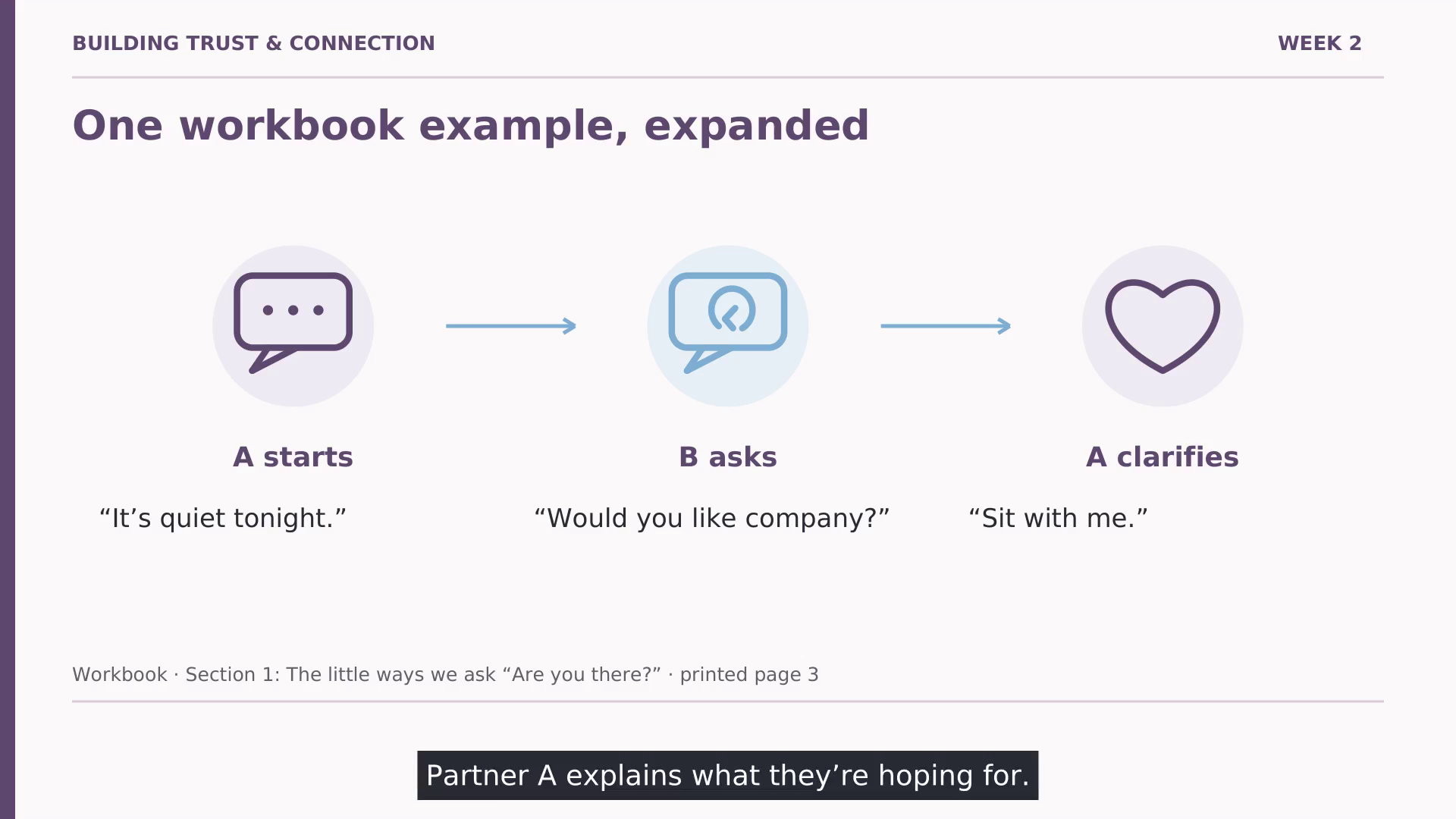
Dev holds out his phone. “Remember this?” Asha glances at her watch. “We should get going.” They make it out the door on time. The little moment Dev wanted with her stays on his phone.
Later, Dev tries again. Asha gets a second chance to hear what he was asking for.
Dev“I wanted to laugh about that trip with you.”
Asha“Oh. You wanted to remember that day together, and all I said was that we had to go. Is that what stung?”
If you really do have to leave, you could say, “Can you show me when we get in the car, before we drive?” Then, once you’re in the car, be the one to ask for the picture.
Open the free 10-minute practicePrintable PDF · Includes the full replay and prompts for both of youOne lesson a week. Something to try in between.
Each week, watch a prerecorded video lesson with Katherine and try one conversation from the matching printable workbook. Pick an ordinary moment and put the words in your own voice. You choose when to practice and what you want to share.
Notice what helps you feel close.
Start by naming the places where trust already feels steady. Notice how each of you reaches out and what helps you stay open.
Week 1The Trust We Have—and the Trust We Want
Name one place trust feels steady and one small change you would both be able to notice.
Week 2Are You There for Me?
Recognize a bid for connection and try a missed moment again while it still feels manageable.
Week 3What Helps You Feel Safe With Me?
Find words for what helps you stay present, including how to ask for space or touch and respect the answer.
Work through what gets in the way.
Practice the conversations that are easy to put off, from a missed commitment to a hurt that deserves an apology.
Week 4Can I Count on You?
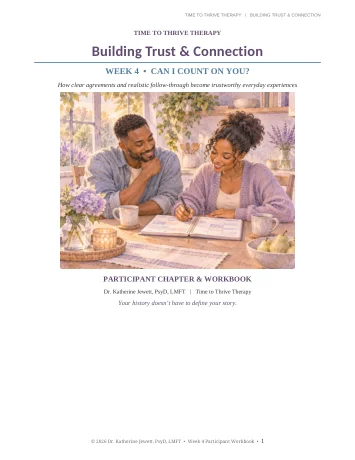
Make a clear agreement about who will do what, by when, and how you’ll handle a change.
Week 5When We Lose Each Other
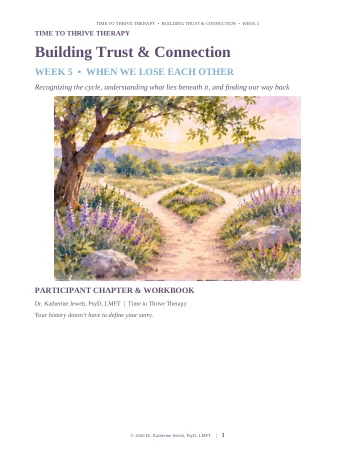
Spot the early signs of your familiar argument and agree on how to pause and come back.
Week 6When Something Hurts
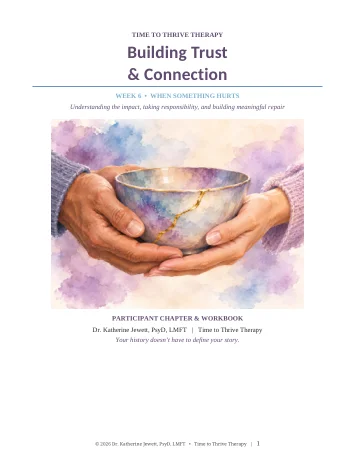
Apologize for the impact of a specific action, make amends, and follow through without asking for immediate forgiveness.
Week 7Hard Conversations, Stronger Partnership
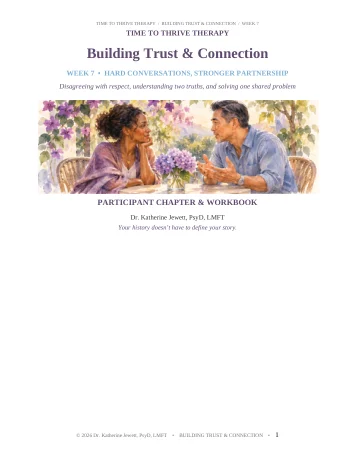
Hear what each partner is trying to protect and turn a recurring disagreement into one small experiment.
Make room for the relationship you want.
Get curious about each other again, protect something you both enjoy, and choose what you want to keep doing.
Week 8Let Me Know You and Let Me Know You Care
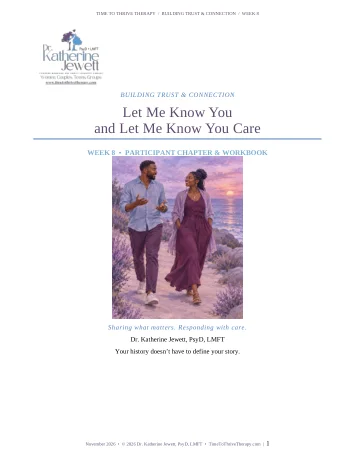
Share a worry, a hope, or good news and tell your partner what kind of response would feel caring.
Week 9Make Room for Us
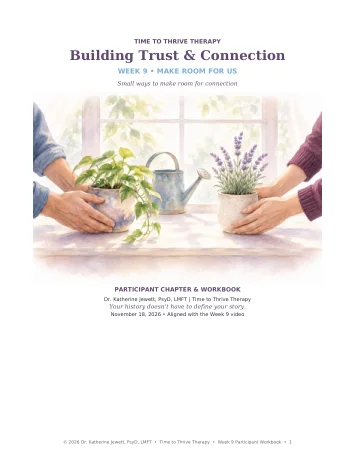
Choose a ritual you both actually want, find a cue for it, and decide whether you’d like to do it again.
Week 10A Relationship We Keep Choosing
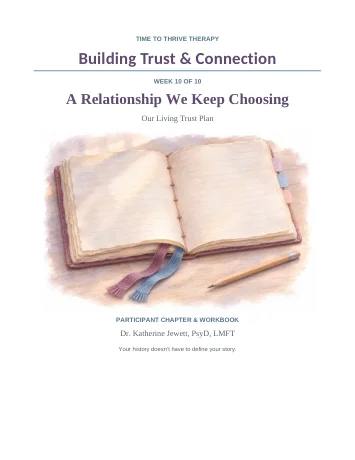
Gather what works in your Living Trust Plan and schedule a 20-minute check-in about 30 days later.
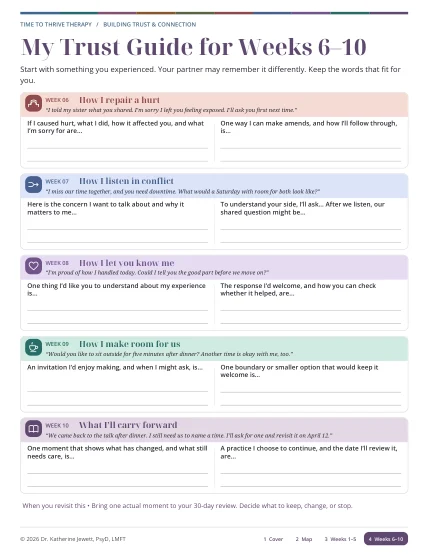
A guide to the two of you,
in your own words.
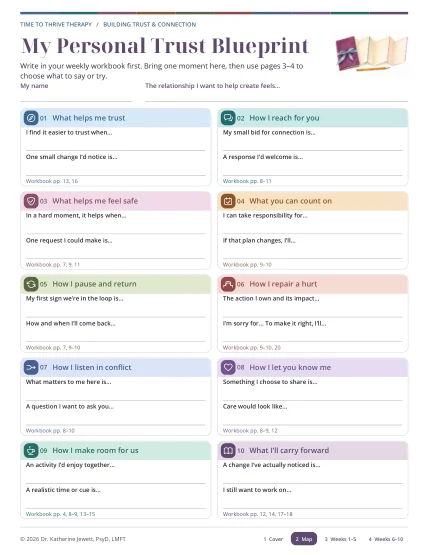
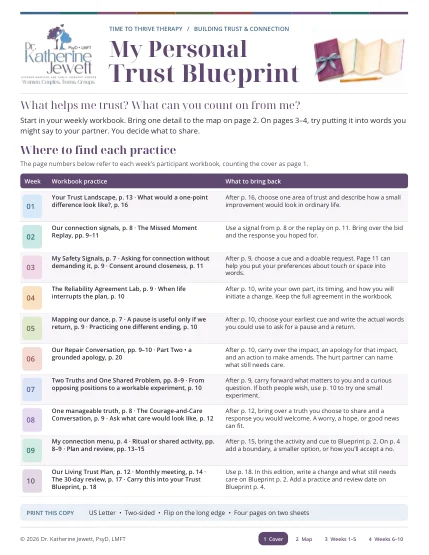
In My Personal Trust Blueprint, you collect one detail each week about what helps you trust and what your partner can count on from you. In Week 10, bring the pieces you both want to keep into Our Living Trust Plan. You’ll have something in your own words to return to the next time life gets crowded.
See the workbooks and Blueprint
Each workbook is a printable PDF. The bindings show how the booklets can look when printed.
My Personal Trust Blueprint
Bring one detail from each week into your own guide. These are two of its four printable pages.

Dr. Katherine Jewett
PsyD, LMFT · California Licensed Marriage and Family Therapist #100342
Course creator at Time to Thrive Therapy
I’ve worked with couples in private practice for more than a decade. Alongside that work, I’ve spent the past ten years studying couple relationships. Both shape the way I teach.
I created this course around the moments you actually have together. When one of you is halfway out the door, you need a sentence you can say right then. And when you’ve hurt someone you love, you need a way to listen long enough to understand what your apology is for. That’s the kind of practice you’ll find here.
You both get a say.
This course is for adult partners who want to feel closer and can each say yes, no, or “can we try that later?” freely. You can use it on your own schedule or bring a practice to a couples therapist you already work with.
This is relationship education. It is not therapy or a substitute for therapy. Read about fit and safety.
Build trust, one week at a time.
Enrollment isn’t open yet. Check back here for launch details.
What’s included
- 10 weekly video lessonsOne new lesson opens every seven days.
- 10 illustrated, printable workbooksChoose from 70+ guided reflections, partner conversations, and at-home practices across the set. Start with one that fits your week.
- My Personal Trust BlueprintA printable guide to what helps each of you trust.
Want to try something now? Start with the free Week 1 trust worksheet.
Questions couples may have
What if I’m the one who wants to start?
Try the free conversation yourself and see if it sounds like you. You can use an individual reflection on your own. The shared practices depend on both people choosing to take part. If you’d like to invite your partner, you might send this message. “I miss laughing with you. Would you try this ten-minute conversation with me after dinner?”
What if we’re already seeing a couples therapist?
You can use the course alongside therapy. If a particular exercise feels relevant, bring it to your own therapist and decide together how it fits. This course is psychoeducation. It is not therapy, does not replace therapy, and enrollment does not create a therapist–client relationship with Katherine.
Will we have to share private things with other people?
There are no live group discussions. You can write privately, share only what you choose, and pass on a question. You don’t have to agree on everything to practice listening to each other.
What if there’s been a serious betrayal, or I’m afraid to speak honestly?
If there’s a significant unresolved betrayal or ongoing deception, individual guidance from a qualified professional can help you decide what support fits. If saying no could lead to threats, control, or retaliation, skip the partner exercises and seek confidential individual support. You can contact the National Domestic Violence Hotline privately when it’s safe for you to do so.
National Domestic Violence HotlineWhen will lessons open?
Once the course opens, Week 1 will be available when you enroll, followed by one new lesson a week through Week 10. You can go at your own pace. There are no live appointments to attend.
Have a moment in mind already?
Start with one you’d both like a second chance at.
Try the free practiceBack to couples therapy